

What’s the best catfish bait? This is a question that newcomers to the sport of catfishing ask every time they venture forth in hopes of catching the makings of a big fish fry! I’ve been catching catfish for a long, LONG time.
My dad was a major trotliner and we did a lot of fishing when I was growing up in rural Red River County. Back then, we used what was readily available. Our farm pond was overrun with small sunfish, thus fresh cut bait was our favorite. We targeted mostly channel catfish back then, and the cut bait always produced well. I remember one time, we headed out on a hurried catfish outing and didn’t have time to catch bait. My dad stopped by one of the country stores and purchased several bars of white, unscented PG soap. We cut the soap into small squares, baited our trotline and proceeded to catch a burlap bag (that’s what we used back then to store our catch) full of ‘eater’ size catfish ranging from 1.5 to 3 pounds. Other times, we rounded up a coffee can full of live nightcrawlers, they also worked well!
In truth, channel catfish can be caught on a wide variety of baits; everything from live crickets to soap will trigger strikes. A couple of decades ago, I began fishing for channel catfish with ‘Punch’ bait, a concoction of cheese, ground up baitfish, fiber such as cattails to keep the bait on the hook and, who knows what else! Today, there is a host of punch baits, so named because treble hooks are punched into the bait container with a stick or screwdriver with a notched blade.
‘Dip baits’ are also very effective. These baits are used in conjunction with a soft plastic, usually ribbed, plastic keeper with built in treble hook that is dipped into the bait or a very soft plastic bell with holes or slots into which the bait is squeezed via a tube. All these baits have one thing in common; they all disperse scent quickly into the water.
Catfish have one of the most highly developed olfactory systems of all fish. Studies have proven that they can detect scent, especially blood and pungent scents from a great distance. Baiting areas with soured grain is a very effective method of attracting catfish, especially channel cats during summer months when the water is warm and scent disperses quickly.
But, according to catfish guide Larry Thomas at Lake Tawakoni, chumming is not always necessary, especially this time of year when channel catfish have moved into the shallows to spawn.
“During the spawn, catfish naturally congregate in large schools," tips Thomas. "Right now it’s easy to locate them if you look in the right places. Secluded coves with plenty of newly flooded shoreline weeds and brush are prime spots for locating channel cats right now. Catfish are cavity spawners and soon they will be packing into the rock rip rap around bridges and roadways.”
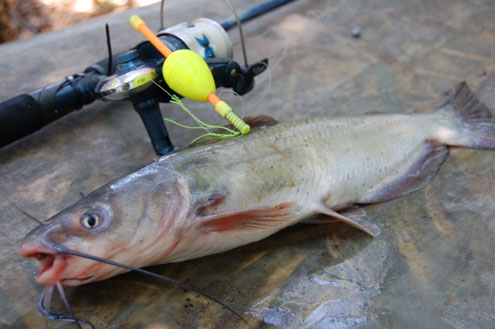
Light tackle is very effective in catching channel catfish when they are in the shallows. photo by Luke Clayton
Blue catfish can also be landed on a wide variety of baits but most serious catters will attest to the fact that nothing beats fresh, bloody, oily shad, either fished whole or as cut bait.
Lake Lavon guide Billy Kilpatrick lives on the shores of Lake Lavon near Farmersville. He says bank fishing has been awesome for both blue and channel during the first couple hours of daylight.
“This type fishing is both simple and productive," says Kilpatrick. "A few throws of a cast net at first light will fill your bucket with shad. We’re using dead shad fished on bottom to catch lots of catfish now and fishing the northeast shoreline that his exposed to a steady south wind.”
Flathead catfish are a bit different and, for most people, tougher to catch. Flatheads prefer live bait and many are caught on trotlines or jug lines set in areas with standing timber. Live perch 2-4 inches long stay alive well and are excellent baits for flatheads. While most are landed on set lines, rod and reel anglers that are willing to be patient and fish live bait around submerged river or creek bends with heavy wood structure also catch their share of flatheads.
Catfish and the sport of catfishing has gained popularity in the last few years. Anglers are learning that catfish are not only excellent table fare but they are also hard fighters. Tournament trails such as Cabela’s King Kat Trail and organizations such as the United States Catfish Association www.catfish1.com have done much to grow the sport.
When we get down to the facts, what more could a fisherman wish for that a species that is abundant, challenging to fish for and, great eating when dusted with corn meal and exposed to hot cooking oil!
*********************************************
Two legendary anglers soon to be honored
I was recently reading the current press releases from Texas Parks and Wildlife and learned some very good news. A couple of guys that have done much to promote the sport of bass fishing through the years will soon be the recipients of a prestigious honor. Professional angler Tommy Martin of Hemphill and lure manufacturer and angler Lonnie Stanley of Huntington will be inducted into the Texas Freshwater Fishing Hall of Fame June 2, 2012, at the Texas Freshwater Fisheries Center in Athens.
Martin began guiding on Sam Rayburn Reservoir in 1968 and fished in his first tournament the following year. He turned pro in 1972 and won the prestigious Bassmaster Classic just two years later.
In 1975 Martin became the first professional bass angler to acquire cash sponsors. He won 19 national tournaments, was a 19-time Bassmaster Classic qualifier and won five B.A.S.S. national titles. He also competed in FLW Outdoors events and qualified for both the Forrest L. Wood Cup and the Stren Series championship.
Martin helped found Texas Black Bass Unlimited, a Texas conservation organization that played a key role in developing the Texas bass fishery into the best in the nation.
He was inducted into the National Bass Fishing Hall of Fame in 2003.
Stanley, owner of Stanley Baits, Inc., started building jigs in 1979 after winning a tournament on Toledo Bend Reservoir with one he’d made. In 1980 he founded Stanley Lures, manufacturing jigs, spinner baits and other products. While continuing to build jigs in his garage in College Station, he won six more tournaments in 1980 and 1981.
Innovative ideas such as interchangeable skirts, silicone skirts and multi-colored skirts helped Stanley build his company into a multi-million-dollar organization. Part of his success sprang from his prowess as an angler and five-time Bassmaster Classic qualifier.
Stanley co-hosted ESPN’s “Sportsman’s Challenge” television series for 18 years.
Throughout my outdoor writing career, I’ve relied on these two pros to supply fodder for articles and fishing information. They are both certainly deserving of the honors they are soon to receive.
Listen to Outdoors with Luke Clayton Radio at www.catfishradio.com.
Noted hunter Larry Weishuhn has joined forces with Luke on the radio programs with his “Campfire talk with Larry Weishuhn. Listen online anytime or live on air on one of the many radio stations. Contact Luke with hunting and fishing news from your area at lukeclayton@prodigy.net.