Bonham -- What are the odds that the most notorious outlaw of the 1880s in Arizona would wind up as a city marshal in North Texas in 1895?
At least 50-50 according to historian and author Randolph W. Farmer.
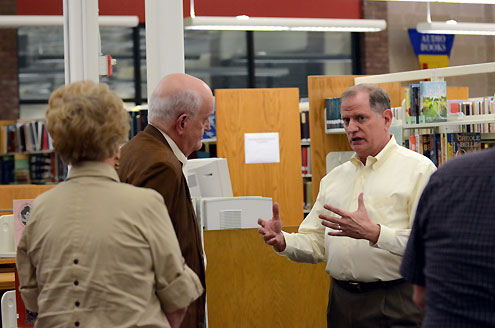
Mr. Farmer was at Bonham Public Library recently to discuss his latest book, "Curly Bill" - Horse Thief, Cattle Dealer, Murderer, Lawman: 1858-1909, a 195-page book that delves into his theory that Curly Bill made the transition from Wild West outlaw to city marshal in Paris, Texas.
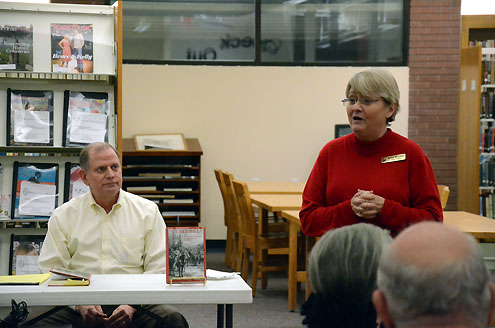
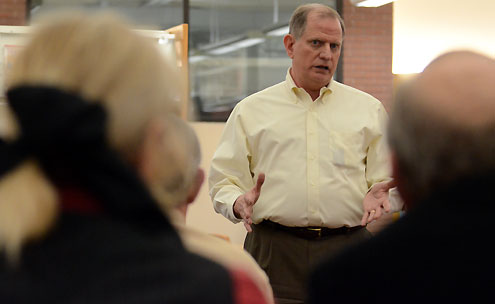
"This book represents eight years of my life," Farmer told the audience. "It became an obsession, but it was an interesting journey."
Farmer's lecture in Bonham seemed appropriate given that the author and historian believes Curly Bill was a Fannin County boy, William A. "Bill" Brosius, who would become infamous in Arizona and California as a gunman and rustler.
"There is so much history here," Farmer said of Fannin County. "It is phenomenal that more hasn't been written about it. People were so used to it being commonplace in their life that they didn't write it down or save photos, which makes it difficult to dig up."
In this particular instance two facts make this case very difficult to solve. First of all, countless aliases and nicknames confuse the issue. And, secondly, the devastating Paris fire of 1916 destroyed crucial evidence.
The first time Farmer recalls hearing the story of Curly Bill was in the 1993 film Tombstone. Kurt Russell starred as Wyatt Earp and Powers Booth played the role of Curly Bill.
"I now know everything in that movie was entirely fiction," remarks Farmer.
As far as the prospect of an outlaw turning over a new leaf and sporting a badge, it was a common practice in the late 1800s. Take the case of Ben Thompson, a gunman, gambler, saloon owner, ex-con and occasional lawman in the Old West. Thompson had once tried to talk John Wesley Hardin into killing "Wild Bill" Hickock, however in 1881 Thompson was hired as the city marshal in Austin, Texas. The crime rate plummeted. After all, no one knows what the outlaws are up to any better than another outlaw.
According to Farmer, there was one important prerequisite to being a city marshal in those days.
"A typical city marshal...didn't mind shooting someone," said Farmer. "It's not surprising that Curly Bill Brosius became city marshal in Paris, Texas, the gateway to Indian Territory and the den of iniquity that existed along Red River."
But even Farmer admits there is a 50% chance that the outlaw Curly Bill was shot and killed by Wyatt Earp in 1882, although the author is quick to point out that it wasn't until 1920 that Earp specifically named Brosius as the man Earp killed almost 40 years earlier in southeastern Arizona's Whetstone Mountains.
"There's the problem," says Farmer. "Curly Bill became part of the Wyatt Earp legend."
Instead, Farmer believes Brosius returned to his roots in North Texas. Marriage records show a W. A. Brosius was wed to William Eubanks's daughter, Annie, in Paris, Texas in 1893. A business listed as Brosius Brothers Kentucky Stables existed on Clarksville Street in Paris in 1884-85.
According to Farmer, Brosius, now going by the first name of "Al", was elected as city marshal of Paris by an overwhelming margin of 901 to 1 and the election was approved by outgoing Paris Mayor Alexander Cate. Al Brosius went on to serve three terms as city marshal.
It should be noted that these were extremely difficult times to be the law in any Red River border town. Farmer's research indicates Paris had 23 saloons in 1901, roughly twice the number of churches in the community. The bordellos were in Boardtown, sometimes referred to as Grangertown, near the intersection of Pine Bluff and Jefferson Street, and this is where Marshal Brosius had trouble with the boys from Delta County in 1899.
When Brosius hung up his badge, one written account states, "He was a faithful and fearless officer, being conscientious and impartial in the discharge of his duty."
So, did the infamous Curly Bill die in1882 from a bullet fired by Wyatt Earp?
Or, could this reformed outlaw have been the faithful civil servant who was laid to rest May 26, 1909 in Paris' Evergreen Cemetery?
"I'm 100% sure that Bill Brosius of Fannin County is Curly Bill," states Farmer.
To order a copy of Randolph Farmer's "Curly Bill" - Horse Thief, Cattle Dealer, Murderer, Lawman: 1858-1909 contact Collin County Historical Society at www.nthc.org