

This year marks the 150th anniversary of the end of the Civil War. In light of that, we will re-run a series of Civil War-related articles noting part of its impact on our area.
In the mid-1840s U.S. politicians and business leaders once again decided that war was necessary to expand the size of the United States, and woe be unto any soul who disagreed with an undeniably patriotic cause. Astute observers knew that President James Polk wanted a war with Mexico in the hopes that it would result in the U.S. border moving west. All Polk needed was a reason – some sort of attack from Mexico, even if it had to be provoked. As Hiram Ulysses Grant (later known as Ulysses S. Grant), a lieutenant in the U.S. Army at the beginning of the Mexican-American War (MAW), noted in his Memoirs: “We were sent to provoke a fight, but it was essential that Mexico should commence it.”
Among those who followed their leaders into battle was a 16-year-old farm boy from Illinois named Cyrus Lathrop. Luckily for Lathrop, the MAW did not cost him his life, thus he could fight again when the Civil War rolled around. The luck of defying death, however, would not stay with him through that conflict. Afterwards, his family scattered in many directions, and some ultimately called Fannin County home.
Born in 1830 (or 1826, according to which source you rely on) in Clark County, Illinois, Cyrus Lathrop, like so many farm boys, over time found life on the farm a bit on the dull side. So when the adventure of going to war - spurred no doubt by tales from his father, Artemus Lathrop, who had soldiered in the Black Hawk Indian War (perhaps alongside fellow Illinois soldier Abraham Lincoln?) - arrived in 1846, he couldn’t resist. He and many other volunteers joined the 1st Illinois Infantry. They were led into the Battle of Buena Vista by future President of the United States, Zachary “Old Rough and Ready” Taylor against Mexican soldiers led by the legendary General Antonio Lopez de Santa Anna of Alamo and San Jacinto fame.
Buena Vista was a bloody affair costing many soldiers on both sides their lives. Fortunately for Lathrop, he survived to one day tell his war stories. His MAW service record states that he mustered out at Camargo, Mexico on June 17, 1847. Apparently impressed with General Taylor, he later named a son Zachary Taylor Lathrop.
Roughly fourteen years later, Cyrus Lathrop again decided to follow the path of war, this time enlisting with Company F of the 59th Illinois Infantry to fight for the Union cause in the Civil War.
One of the first fights that the 59th Illinois engaged in was the Battle of Pea Ridge, in northwestern Arkansas. Unknown to Lathrop was the irony of it all. At Pea Ridge he squared off against many Confederate soldiers from Fannin County, led by Captain Gideon Smith, one of Fannin County’s largest plantation owners. He could not have foreseen that one day some of his descendants would move to Fannin County to live amongst Smith and some of the Confederate veterans from Pea Ridge.
Sometime after Pea Ridge, Lathrop was assigned to be part of the U.S. Ram Fleet, a group of boats that carried out maneuvers up and down the Mississippi River. It was there that he perhaps realized his fifteen minutes of Warholian fame. The History of the Ram Fleet and the Mississippi Marine Brigade in the War for the Union on the Mississippi and its Tributaries, published in 1907 in St. Louis, states that Lathrop, along with a few others from the Lioness, one of the crafts of the Ram Fleet, stormed up the bluffs of the Mississippi to raise the U.S. flag above the “custom house or federal building” in Memphis, Tennessee, once that city had been wrested from the hands of the Confederates. To quote from the text:
(T)wo soldiers of the boat’s guard of sharpshooters (Cyrus Lathrop and William H. McDonald) each carrying a wrapped flag under his arm, stepped quickly ashore in the midst of a throng of onlookers, with which the bluffs on the city front were lined, and hastily made their way up the street, with the crowd following, or hurrying ahead on either side. Reaching the city building, the party found the mayor in waiting...
The mayor warned Lathrop and his companion that they might be “harmed by an irresponsible mob” if they attempted to raise the U.S. flag over Memphis. Nonetheless, the flag was raised and the crowd from which an angry mob might arise ultimately thinned out.
Not long after that moment of glory faded into memory, the grim reaper came calling. By late 1862 Lathrop became very ill. His Civil War service record states that he died “on board the U.S. Ram fleet off Helena, Ark.,” on September 11, 1862 of “acute gastritis.” Like most Civil War casualties, Cyrus Lathrop was done in by sickness rather than actual combat.
In a prophetic letter to his wife, Cindicy, dated December 11, 1861, Lathrop indicated his understanding that death might one day find him. Bad grammar and punctuation aside, Lathrop’s lines ring eloquent:
My dear wife, I hope that we will see each other some time before we die, but, dear wife, if we do not see each other here on earth, I hope we will meet again in Heaven, where parting is no more, but where we shall strike glad on those sunny banks of deliverance where we will be forever blessed. I am determined to meet you there, my dear wife.
Among Lathrop’s many survivors was a 4-year-old daughter named Sophronia Ethleen. She would eventually marry an Illinois farm boy who had managed to survive the Civil War, Hiram Burrell.
By the 1880s, Hiram and Ethleen Burrell moved to Fannin County and called the Ivanhoe area home. There they would raise crops, mainly cotton, as well as kids.
One question that has always bugged me is: What prompted the Burrells to leave Illinois for Texas? Fortunately, Lathrop family records seem to offer a clue. It seems that an aunt of Ethleen’s, Sarah Lathrop (sister to Cyrus), had moved to Texas in the 1850s. She married a lad named Daniel Anderson Wells in Grayson County in September, 1855, and they lived there for roughly 20 years. It is safe to assume that tales of life in Texas flowed from Sarah to her niece and her husband in Illinois, prompting them to take a stab at life in the Lone Star State.
Today, some 125 years later, many descendants of Ethleen Lathrop Burrell and her father, Cyrus Lathrop, still call Fannin County (and some Grayson County) home.
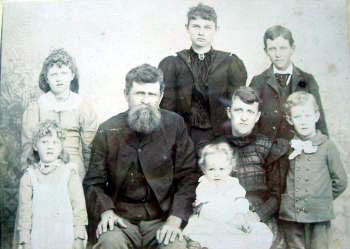
Many thanks go out to John Michaud, another descendant of the Lathrops and Burrells, for all of the research materials and photograph that went into this article.
Tim Davis teaches at Bonham High School.