With the beginning of each year, I begin thinking about all the exciting things coming up in the outdoors. Muzzleloader deer season opens in a matter of days, and I have my CVA 50 caliber Optima all cleaned, sighted in and ready to go.
If there was an official hog hunting season it would begin with the close of whitetail season. I absolutely love hunting wild hogs year around but there is no better time than cold weather for putting that great eating wild pork in the freezer.
Spring turkey season is only three months away and there are not many things that gets my blood pumping like the sound of a big gobbler answering my call from back in the woods on a spring day when the woods are adorned with those first touches of green.
The first fishing event of the year, other than fishing stocked ponds and city lakes for rainbow trout, is the white bass run. I look forward to fishing creeks above our many lakes with healthy white bass populations during the spring ‘run’ which often begins in early February and lasts through April. But there is no better time than the present to stock the freezer or have a fish fry of freshly caught white bass fillets.
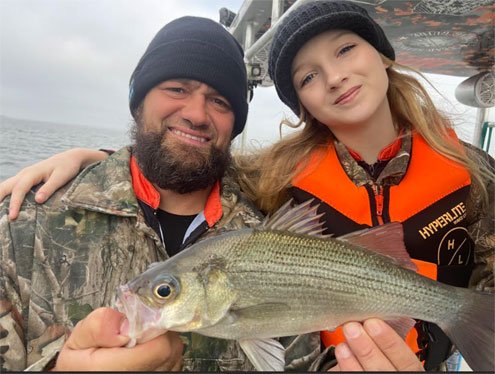
This past week, I joined Lake Ray Hubbard guide Brandon Sargent with Lead Slinger’s Guide Service and good friend Jeff Rice for some fast-paced white bass catching. This time of year, white bass stack up on the lower end of lakes in huge schools and go on a feeding frenzy in preparation for their spawn. In a few weeks, depending on weather and rainfall, they will begin their annual migration up toward the creeks and rivers that feed the lake but right now the majority of ‘whites’ can be found in the lower lake and catching can be red hot.
As Brandon eased “Big Bertha”, his big guide boat out of Sapphire Bay Marina, he gave Jeff and I a preview of how he expected the morning to go.
“We will fish the lower lake, and I’ll be looking for huge balls of baitfish (shad) in water around 20 feet deep," he informs us. "Find a heavy concentration of bait and we will find the white bass. Let’s head to a spot that has been packed with both white bass and baitfish. I’ve been limiting out in this area on most recent trips; occasionally it’s necessary to move a bit to keep up with the fish but the area has been consistent for catching jumbo size white bass with many in the 14–16-inch range.”
As we approached the area he had been fishing, the GPS trail on his graph looked like a bowl of spaghetti, it was obvious he had spent a great deal of time in these few acres of the lake the past few trips.
We didn’t begin fishing immediately, Brandon studied his sonar carefully and we watched several small balls of bait pass under the boat. He noted that we could catch a few fish from these small schools but not the motherload would be holding around the big concentrations of bait.
After a few minutes of searching, he activated the Spot Lock that keeps the boat perfectly positioned, turned on his BoBo’s thumper and the little trolling motor that churns the water on the surface. Game fish are attracted to the thumping sound and the water churning on the surface helps trigger the bite. One the screen of his forward-facing sonar, clouds of white bass began to show, many in a vertical pattern that indicated feeding fish.
We were using half-ounce lead slabs that Brandon custom builds and the drill was to position the baits just above the fish and slowly crank them up, mimicking a baitfish fleeing for its life. Almost every strike came as the fish came from below to catch the bait. For many years, I’ve caught white bass in the dead of winter by keeping slabs right on bottom.
Back in the days before modern sonar, we had no idea they would chase baits vertically up the water column in the winter when the water was cold. I tried my old winter pattern of dropping the slab to bottom and just holding it there, giving a slight jiggle to the rod to imitate a wounded shad but nary a bite! I have no explanation as to why this old method did not produce but I didn’t stick with it very long...the whites wanted a vertical presentation and that’s what we gave them.
Ray Hubbard was first stocked with pure strain striped bass back in the '70s, '80s and early nineties before learning that hybrid stripers were a better choice for inland lakes. I caught my very striped bass back in the early eighties very close to where we were fishing. Many younger anglers or newcomers to Ray Hubbard have no idea the lake used to provide good striper fishing.
Back twenty years ago, RH produced lots of big hybrid stripers, a cross between a pure striper and white bass, I’ve caught a lot of hybrids here in the 6- to 10-pound range, mostly on live perch or shad. Thanks to a recent aggressive stocking program by TPWD, it’s again common to catch hybrids. We landed several on this trip that were just under the legal limit of 18 inches. Hybrids are fun to catch and great table fare. Before long, possibly next summer, these hybrids will be of legal length. Right not, it’s important to check your catch carefully when white bass fishing. It’s easy to mistake a 15-inch egg-laden white bass for a hybrid striper.
We kept enough of the white bass for a great meal of tasty fish tacos back at the marina, prepared by Chef Brandon!
The key to a good tasting white bass fillet is to remove the red meat. The fillets on larger white bass have a thin layer of red meat on the outside of the fillet which can easily be trimmed by leaving the fillet knife blade an eighth inch or so above the skin side of the fillet. Properly trimmed white bass are great tasting fish and it takes little time to trim the red meat.
Brandon is also doing evening wild hog hunts near Crandall using thermal scopes around corn feeders. To learn more about his fishing and hog hunts, contact Lead Slingers Guide Service at 469-989-1010.
Listen to Luke’s weekly radio show/podcast “Catfish Radio with Luke Clayton” just about everywhere podcast are found. Email Luke through his website www.catfishardio.org