Texas A&M’s Carmen Reisdorf ’27 built a citizen science project linking AI, ecology and global volunteers
When Texas A&M University freshman Carmen Reisdorf ’27 walked into her Fundamentals of Ecology class, she expected to learn about ecosystems — not launch a research project connecting hundreds of people around the world.
Reisdorf, a student in the Department of Ecology and Conservation Biology in the Texas A&M College of Agriculture and Life Sciences, built an online citizen science project hosted through Zooniverse, a global citizen science platform where anyone can help scientists analyze data. Her project asks volunteers to identify bird calls from the Edwards Plateau, helping researchers understand how land management practices affect wildlife.
What makes the project remarkable isn’t just its scope, but that Reisdorf created it as an undergraduate from concept to launch.
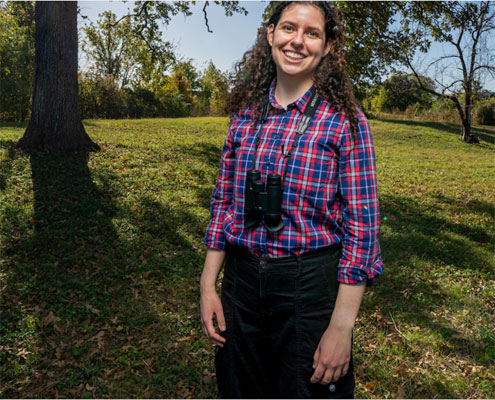
“It started as a class project,” she said. “I was just a freshman taking Dr. Ben Wu’s Fundamentals of Ecology course, and I needed a small honors project. I walked into his office on a Thursday afternoon and asked if there was something I could do to help with his research. He said, ‘Let’s see what happens.’”
What resulted from that conversation was more than expected. Over the next three years, Reisdorf’s project grew into an international effort that has drawn more than 900 volunteers and produced over 70,000 classifications of bird sounds since launching publicly in June.
“Even though our project features a specialized task, we’ve measured high volunteer accuracy rates so far,” Reisdorf said. “Because they work together to build consensus in our repeated-classifications approach, our volunteers don’t have to be bird experts to be a powerful voice in bird research.”
Turning sound into science
The idea stems from a larger United States Department of Agriculture-funded collaborative effort known as the Prairie Project, which studies rangeland restoration and sustainability across Texas, Oklahoma and Nebraska. Wu, Ph.D., professor in the Department of Ecology and Conservation Biology, serves as a co-primary investigator for the project and leads both the ranch-scale studies and its education component.
“Carmen’s work stands out as both excellent and innovative,” Wu said. “By combining AI and crowdsourcing through citizen science, she’s helping us explore how prescribed fire and grazing shape bird communities across savannah landscapes — something that wouldn’t be possible with traditional methods. Her project also enhances our teaching by giving undergraduates a hands-on way to practice scientific inquiry and critical thinking.”
At Texas A&M AgriLife Research’s Martin Ranch in the Edwards Plateau, researchers use 23 audio recorders to monitor bird activity at sunrise and sunset. Those recorders have produced more than 20,000 hours of audio since 2022, far too much for one student to review manually.
“I realized it wasn’t realistic to listen to every minute of every recording,” Reisdorf said. “I looked for ways to combine technology with community involvement.”
She used BirdNET, an open-source artificial intelligence, AI, model created by the Cornell Lab of Ornithology and Chemnitz University of Technology, to generate initial predictions of which bird species were present. The AI is powerful but imperfect as it can sometimes misidentify sounds, so Reisdorf designed a way for human volunteers to verify its results.
Through her Zooniverse project, titled “Savanna Spy: Sound,” users listen to short clips and confirm or reject the AI predictions. Each sound is reviewed by 15 people, allowing researchers to build consensus and refine the model’s accuracy.
“People are helping us separate true positives from false positives,” she said. “It’s a way to improve the data while teaching volunteers about birds, ecosystems and how sound can tell us what’s happening in the environment.”
Leading as a learner
For Reisdorf, the project has been as much about growth as research. A self-taught coder, she learned Python, R and HTML to manage and visualize her data. She also developed the communication skills to recruit volunteers and share her findings with academic and community audiences.
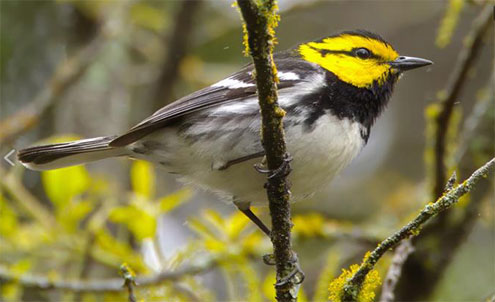
Since starting the project, she has presented her research at conferences, spoken to the local Audubon Society chapter and earned the College’s Dean’s Outstanding Award for Undergraduate Research.
“This project has pushed me to learn things I never thought I’d touch as an undergraduate,” she said. “It’s taught me that I should never be afraid to teach myself something new.”
She credits her success to the support of her mentors, especially Wu, who guided her through the process of turning a class idea into a full-scale study.
“Dr. Wu has been incredibly supportive,” she said. “He trusted me to take the lead and figure things out. I could not have brought it this far without his encouragement and his team’s help.”
Wu said Reisdorf’s independence and creativity stand out among undergraduate researchers.
“Carmen approached this work with the curiosity and drive of a graduate student,” he said. “She took an idea from concept to execution and built something that is making a real contribution to both science and education.”
Listening to the land
Reisdorf’s work helps scientists evaluate how birds respond to pyric herbivory, a land management practice that combines prescribed fire and grazing to restore savanna habitats. The approach aims to maintain open grasslands that support biodiversity and ranching alike.
“Birds are indicators of ecosystem health,” Reisdorf said. “By monitoring their sounds, we can learn how these habitats are changing and whether our management strategies are working.”
For Reisdorf, who grew up in Sharpstown in southwest Houston, the connection between people and nature has always been important to her.
“I grew up seeing this disconnect between people and the natural world,” she said. “That’s part of why I want to make science accessible. Projects like this help close that gap.”
She has already inspired others to join in. Students pitch in during spare moments, retirees have taken part from home and bird enthusiasts from around the world are contributing data to the Texas study.
“It’s humbling,” she said. “I see people worldwide helping us understand Texas ecosystems, and it reminds me that conservation is a shared responsibility.”
As she prepares to graduate early next year, Reisdorf plans to stay at Texas A&M to pursue a master’s degree and continue developing her research. She hopes to continue growing the project while keeping community participation at its heart.
“Technology can make research faster, but people keep it meaningful,” she said. “Every person who listens to a recording learns something about the environment, and that connection is what makes conservation a shared endeavor. When I go into the field and hear those same birds in person, I think about all the people who helped identify them in the Zooniverse project. It feels like we’re all listening together.”