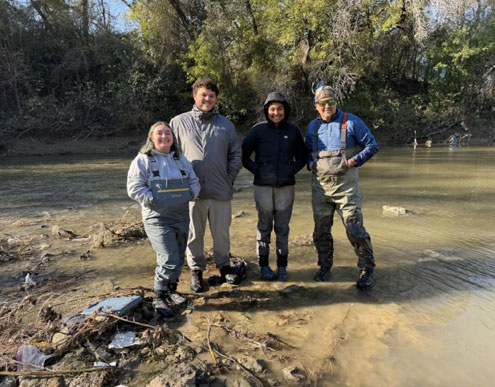
On a cool morning along the West Fork of the Trinity River, NRI researchers waded carefully through flowing water to check a series of mussel silos submerged along the riverbed. These silos, concrete domes with a central opening that houses juvenile mussels and allows water to flow through, are a part of a project examining how water quality influences mussel growth and survival. The field team is led by research associate Rachel Carpenter and supported by Dr. Charles Randklev, research scientist and head of NRI’s freshwater mussel program.
This project is part of a long-standing partnership with the Trinity River Authority (TRA), the Texas Parks and Wildlife Department (TPWD), and the U.S. Fish and Wildlife Service (USFWS). Together, these organizations are collaborating to better understand the ecological conditions shaping mussel populations in the Trinity River basin, which is home to several of Texas’s most imperiled species.
Why mussels are key to understanding river health
Freshwater mussels are among the most reliable biological indicators of ecosystem health. Their sensitivity to pollutants, shifts in water chemistry, and changes in sediment loads make them early-warning sentinels for river systems. At the same time, mussels are ecological powerhouses filtering water, stabilizing sediment, and contributing to overall aquatic diversity. We often refer to them as the “liver of the river”.
Yet, across North America, mussel species are disappearing at an unprecedented rate. Habitat fragmentation, water quality degradation, altered hydrology, and land-use change have contributed to steep declines. Conservation scientists, including those at NRI, now face a critical challenge: species declines are outpacing the research needed to protect remaining populations.
Randklev’s lab focuses on closing this gap. By studying unionid mussels as long-lived, highly sensitive species, the team evaluates river health and tests ecological theories that can inform more effective conservation strategies.
“This research will provide us much needed information on how mussels respond to changes in water quality, helping guide conservation and management actions that strengthen the overall health of the Trinity River,” Randklev shared.
A multi-year research program with real impact
NRI’s mussel program has grown into one of the leading applied research efforts in integrating mussel ecology with hydrologic science to evaluate risks to stream and river ecosystems and to guide efforts that safeguard and protect aquatic species. Under Dr. Randklev’s leadership, the team has conducted basin-wide assessments, rediscovered populations of species believed to be rare or declining, and worked closely with state and federal agencies to inform listing decisions and recovery planning. “This silo study is the critical first step for mussel conservation and recovery efforts in the upper Trinity River basin and will provide valuable information on next steps for the conservation of these species”, said Clint Robertson, TPWD Freshwater Mussel Conservation Coordinator.
For TRA, understanding mussels is part of understanding basin-wide ecological integrity. “As indicators of both quality habitat and good water quality, native mussels provide a piece of the puzzle in understanding the current and future water quality challenges within the Trinity Basin”, said Ryan Seymour, TRA Environmental Scientist. TRA staff routinely assist in research, provide access to reach-specific data, and coordinate mussel relocation efforts during major construction projects, all with the goal of ensuring the best available science underpins conservation decisions.
Linking water quality to mussel growth
While NRI has long focused on documenting distribution, abundance, and habitat characteristics, Carpenter’s project adds a new dimension by testing how water quality, an essential component of mussel habitat, shapes growth directly in a natural river system.
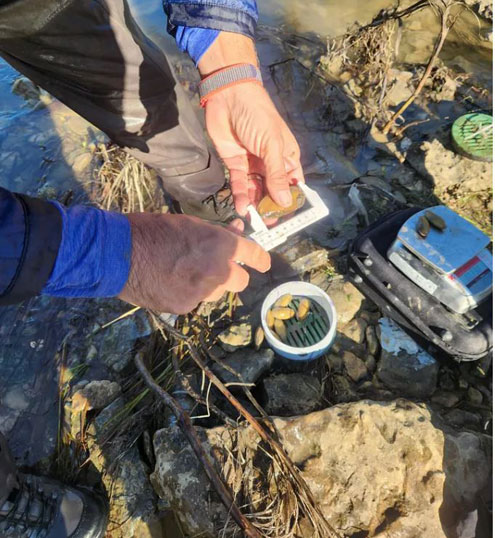
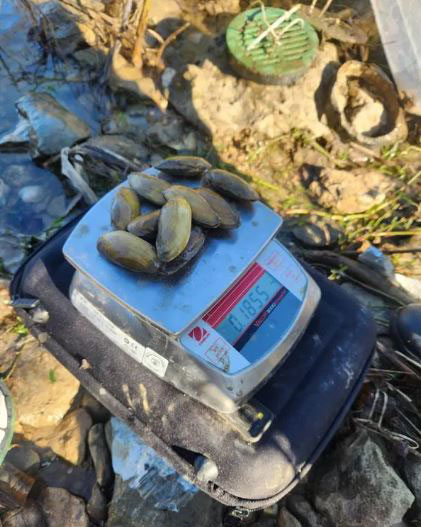
During their sampling trip, Carpenter and the team collected water-quality data, including temperature, dissolved oxygen, pH, turbidity, and conductivity, as well as growth measurements of mussels at selected Trinity River sites. By pairing these datasets, the project aims to answer a few questions:
Which water quality parameters most strongly influence juvenile and adult mussel growth?
How do shifts in river conditions affect mussel health?
Can growth patterns be used to predict long-term population viability?
Understanding these relationships is essential for assessing river health, understanding threats to aquatic species and forecasting how mussel populations may respond to future environmental change.
“Growth is a powerful measure of ecological stress,” Carpenter explained. “By linking growth rates to water quality trends, we can better understand how mussels are experiencing and responding to conditions in the river.”
Looking ahead
As the project continues, the research team will analyze growth trends across different environmental conditions, building models that link mussel physiology to river health. Their findings will contribute to a growing body of work positioning mussels as essential indicators of broader ecosystem function.
For Carpenter, Randklev, and their partners, this research underscores the value of long-term collaboration. By combining expertise in ecology, water management, and conservation policy, they are charting a clearer path forward for protecting Texas’s freshwater biodiversity.