From my earliest memories, sliding around on the back bench seat of my Dad’s 1949 Plymouth, untethered by a seat belt, I’ve always been a car guy. I couldn't wait until I was old enough to drive myself. My fondest automotive memories are of my second car and first love: a 1967 Pontiac GTO, a true American muscle car. I have lots of memories cruising the main drag and even racing other young fools if I'm being totally honest. As I matured (a nice way for me to say gotten much older decades later) I've had the good fortune to represent many luxury and performance car brands along with the opportunity to drive many of them.
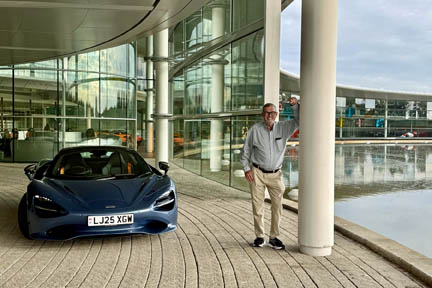
I've grown to have to a deep appreciation for the precision and innovation of modern supercars...especially McLarens. Recently I had the opportunity for a private tour of the McLaren Technology Centre (MTC) in Woking, Surrey, UK.
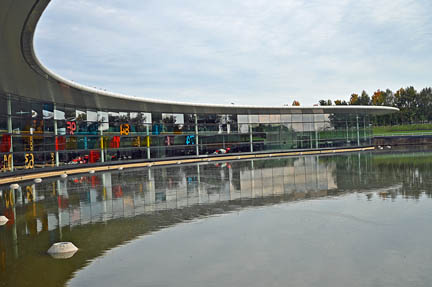
Viewed from above, the MTC and its surrounding lake form a perfect circle— a Yin and Yang of nature and technology, nestled within a carefully maintained ecosystem. The design brief was to make it feel “90-percent NASA and 10-percent Disney.” The MTC fully accomplishes both goals—strikingly futuristic yet teeming with a rich heritage.
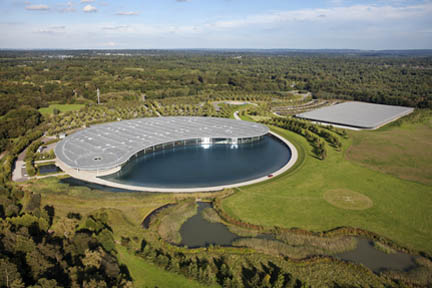
When McLaren converted the former ostrich farm into their global headquarters in 2004, they planted more than 100,000 trees and shrubs. The man-made lake holds 30 million liters (about 8 million gallons) of water, which circulates through heat exchangers to cool the building and dissipate heat produced in the wind tunnel.
Marking its 20th anniversary in 2024, the MTC remains a marvel of modern design with its Production Centre seamlessly linked to HQ via an underground tunnel.
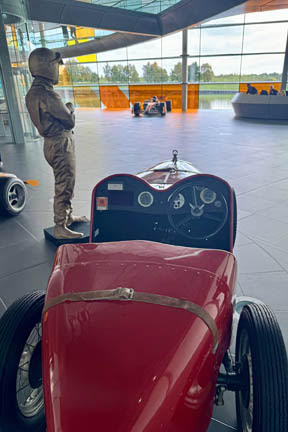
Just inside the MTC’s expansive entry, which is referred to as “The Boulevard,” is a statue of McLaren founder and racing legend Bruce McLaren standing next to the Austin 7 Ulster race car he restored as a teenager. Some consider it McLaren’s first race car, the genesis of the brand’s DNA. The MTC is part museum - part production facility – part futuristic laboratory, developing innovative technology for both the racing teams and production cars.
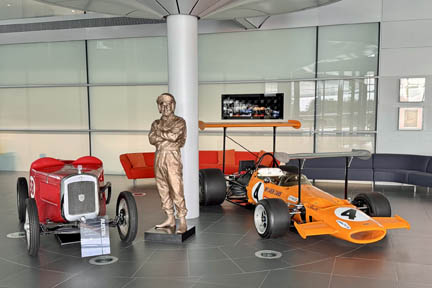
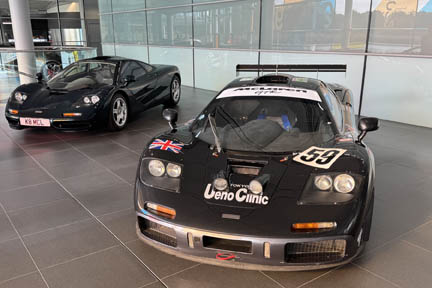
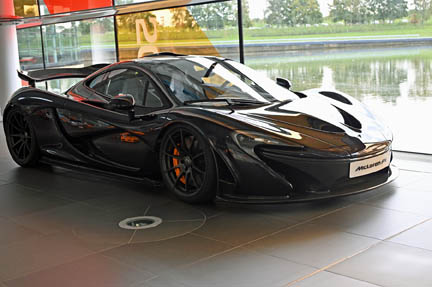
McLaren is an innovator in both racing and road cars. In 1981, McLaren introduced a carbon fiber chassis into Formula 1 with the McLaren MP4/1. In 1993, it built the legendary F1 road car, which also featured a carbon fiber chassis and established McLaren’s supercar DNA. In 2011, McLaren introduced their first production car: the McLaren 12C. In 2013, they delivered the P1™, the first hybrid hyper car.
While photography is not allowed inside the Production Centre, it can only be described as pristine. Very calm and orderly. With only one production shift, McLaren produces an average of 22 cars per day.
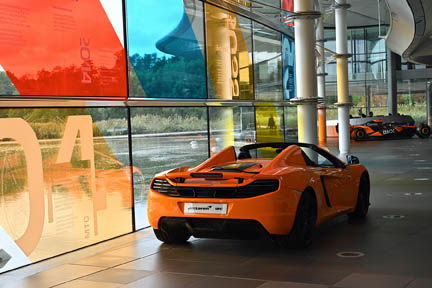
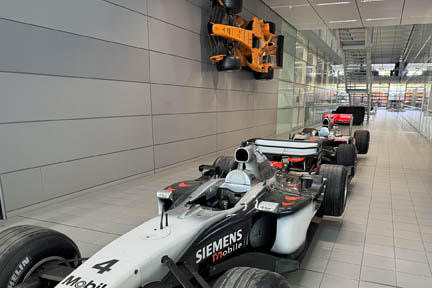
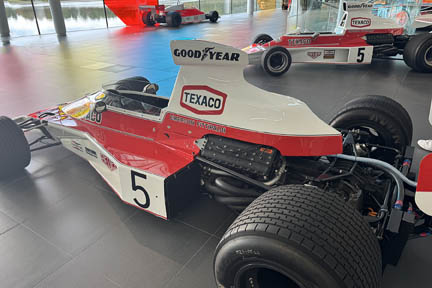
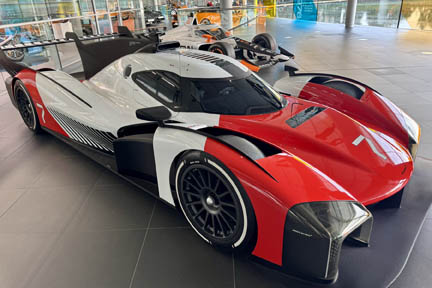
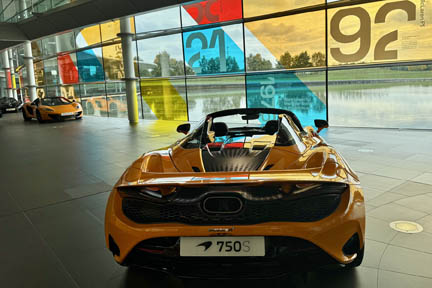
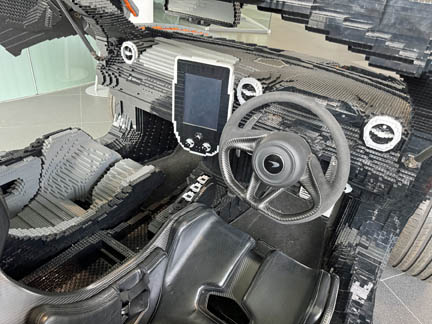
Throughout the headquarters, innovations in racing and production are displayed, including celebrated race cars and renowned road cars. A full-scale LEGO® McLaren Senna, made with more than 468,000 bricks, and featuring working sounds and lights, and Pirelli P Zero Tires, demonstrates the imagination at work within the hallowed halls. Weighing in at nearly 2-tons, it is probably the slowest McLaren ever built. But it is a magnificent work of art.
***image14:center**
McLaren Racing recently won the 2025 Formula 1 Constructors' Championship, clinching the title with six Grands Prix and three Sprints still to go. This was the team's 11th overall Constructors' title and marked their first back-to-back championship since 1991.
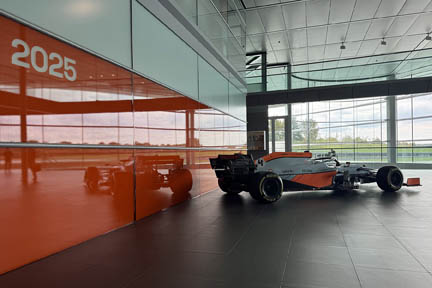
McLaren has posted too many wins to list here, but they include 203 Grand Prix wins (including 13 F1 Drivers Championships and 11 Constructors Championships), 27 INDYCAR wins (including 3 INDY 500 wins), 43 Can-Am wins, and a 1995 win at Le Mans. McLaren is one of only three constructors, and the only team, to complete the Triple Crown of Motorsports, with wins at Le Mans, the Indianapolis 500, and the Monaco Grand Prix. McLaren Racing F1 driver Lando Norris won the Formula One World Drivers' Championship in 2025, and has won 11 Grands Prix across seven seasons.
Lining two long walls in the MTC are display cabinets housing dozens of the most prized racing trophies from victories across the globe. Dwarfed by some of the elaborate trophies in the case is a simple trophy that Bruce McLaren won when he was 15 years old. Some consider Bruce’s first trophy to be the most important win of all, sparking a passion that still powers McLaren today.
More info on McLaren is available at mclaren.com.