Dairy producers are facing a decline in milk prices but beef prices are up and providing added revenue to help them weather the storm, according to Texas A&M AgriLife Extension Service dairy specialists.
The beef-on-dairy breeding program is as much or more of their business as the milk marketing, said AgriLife Extension dairy specialists Jennifer Spencer, Ph.D., assistant professor, Stephenville, and Juan Piñeiro, DVM, Ph.D., associate professor, Canyon, both in the Texas A&M Department of Animal Science.
“Today, dairies are depending more on calf prices, where beef-on-dairy calves have gone from $600 per calf in 2024 to as high as $1,500 per calf for Holstein/Angus cross calves now,” Piñeiro said.
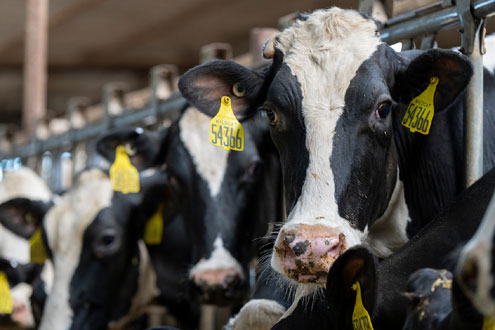
He said recent data from CattleFax indicated 3.22 million beef-on-dairy animals were sold in 2024, where 10 years previously, there were only 50,000 head sold. This is also helping the dairy industry fill supply gaps within the beef industry amid historically tight cattle supplies.
In the marketplace
The Southwest Marketing Area Market Administrator’s Jan. 13 report showed Texas milk production increased by 1.2 billion pounds from 2024, increasing from 17 billion pounds in 2024 to 18.2 billion pounds in 2025.
Spencer and Piñeiro said this is primarily due to the increased number of dairy cows in the state, as well as improved genetics, nutrition and practices that promote cow comfort.
The Statistical Uniform Price report showed milk prices decreased from $20.55 per hundredweight in December 2024 to $16.93 per hundredweight in December 2025. Cheese prices also decreased from $18.62 per hundredweight to $15.86 per hundredweight, for the same time periods.
Butter prices declined the most, from $2.50 per pound in July 2025 to $1.50 per pound by December, according to the report.
The price of butter is going down because cows are producing milk with higher butterfat content due to genetic and nutritional improvements, Piñeiro said. It’s a case of supply and demand. Dairy producers don’t get paid by fluid milk, but rather by milk components such as butterfat and protein. While the protein price has gone up slightly, the increase in butterfat has prompted those prices to decline.
Texas dairy consolidation continues
Overall, consolidation continues among Texas dairies, with operation numbers decreasing, but the number of dairy cows increasing, Spencer said.
According to the U.S. Department of Agriculture National Agricultural Statistics Service, Texas lost 10 dairies in 2024 and another 10 in 2025, going from 294 to 274 in the past two years. Cow numbers, however, increased from 675,000 to 705,000 head in the same period.
Based on the current and expected milk processing capacity, both Spencer and Piñeiro said that Texas milk production is expected to continue growing in 2026 but at a slower rate compared to the previous 10 years.
Some of that slowdown is due to dairy expansion in other states. An example of this is the considerable expansion in western Kansas over the last three years. Another part, Piñeiro said, is the ongoing water challenges in the Texas Panhandle.
Piñeiro said from 2016 to 2021, Texas milk production increased at an average rate of 7.6% per year. From 2024 to 2025, it slowed to 7%. Similarly, from 2016 to 2021, Texas dairy cow inventory increased at an average of 4.6% per year. From 2024 to 2025, that growth was at 4.4% per year.
“Keeping the same high rate of expansion we have had for the last 10 years would be challenging as more cows would demand more forage production and more forage production would demand more water,” he said.