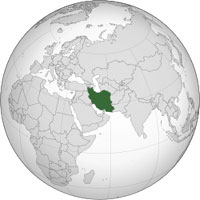
Iran has steep mountains and plateaus across the center and north, with desert in the southeast. This makes the terrain closer to Pakistan and Afghanistan to the east, as opposed to the mostly flat plains in Iraq to the west and the open deserts of Saudi Arabia to the southwest. This terrain has helped Iran resist waves of invasions over the centuries, but it has not made it immune to conquest.
Iran is one of the oldest continuously inhabited areas in the world. Artifacts up to 100,000 years old have been found in some areas. Around 3000 BC, they became among the earliest peoples to develop writing. Its position made it a vital link in the ancient trade routes connecting China and India with Mesopotamia, Egypt, and Europe.
Between 646 BC and 550 BC, Iran fell under control of the Assyrians and the Chaldeans. By 529 BC, the newly independent Persians controlled territory from Afghanistan to Turkey to Egypt, making it the largest empire in history to that point. Attempts to push into Europe proved difficult. This expansion sparked years of warfare with the Greeks starting in 499 BC, leading to the invasion by Alexander the Great by 334 BC. Within three years, Alexander had crushed the Persians.
For centuries, Persia clashed with the Romans and Byzantines. In AD 633, Muslin armies invaded from Arabia. Taking advantage of the deep divisions among the Persians, the Muslims conquered them by 650, leading the majority to convert to Islam and away from Zoroastrianism, another monotheistic faith. This portended a major shift in Persian culture.
By the early 1900s, Iran found itself squeezed between Russian influence from the Caspian Sea to the north and British influence across the southern half of the country. Changes were coming. In 1906, the king, or shah, allowed a limited constitutional government, and oil was discovered in 1908. But continuing unrest led to Iran’s occupation by the British and the Russians during World War I.
In 1925, Reza Shah, an army officer, seized power. He offered reforms but was criticized for oppression and corruption. By 1935, the shah declared that the official name would change to Iran from Persia. Persia had mostly been a Greek term for the region while local variations on "Iran" were common for centuries. His attempt to modernize mosques and dress styles enraged fundamentalists, leading to his ouster by Mohammad Reza Shah in 1941. During World War II, Iran maintained a close position with the Allies, supplying oil and funneling war materiel to Russia.
After World War II, the US enjoyed a warm relationship with Iran, with a steady trade in oil and advanced American weaponry. Shah Mohammed-Reza formed a two-house parliament, but elections were limited. However, Iran was caught between the desire for peaceful relations with Communist Russia and its desire for protection from the US. The shah clashed with Prime Minister Mohammad Mossadeq in the early 1950s, each briefly forcing the other from power. Mossadeq’s efforts at democratic reforms and nationalizing the oil industry led the shah to launch a coup against him in 1953, aided by the CIA.
The shah assumed full power. By the 1960s and 1970s, Iran’s major cities looked like much of the western world,, with fully modern conveniences and women openly enjoying the right to education and their own professional careers. But hatred for the shah’s opulence in the face of poverty and the arrests and torture of dissidents grew.
By the 1960s, the only effective opposition was through the mosques. Ayatollah Ruhollah Khomeini was exiled in 1964. As an ayatollah, he was considered one of the leading figures of the Muslim faith.
Ayatollah Khomeini, and his successor, Ayatollah Ali Khameini, were believed to be direct descendants of the Prophet Muhammad, giving them even greater prestige among Muslims.
In 1978, the people of Iran erupted into protests against the shah. He was quickly overthrown, and he and his family went into exile. Shortly afterward, Ayatollah Khomeini returned, and his followers launched a revolution that imposed a strict theocracy over Iran, with the ayatollah commanding most of the political and religious power.
When the deposed shah was allowed into the US for cancer treatments in 1979, it sparked riots that led to the capture of the US Embassy, with 56 hostages held for nearly two years.
Saddam Hussein invaded Iran in 1980. The eight-year Iran-Iraq War left one million dead. In the meantime, the fundamentalist rulers of Iran have stripped the population of what few rights they had and executed thousands of dissidents across the country. After a wave of protests erupted across Iran earlier this year, the army executed up to 20,000 protestors, according to observers.
While more than 96% of Iranians today are Muslim, they are often at odds with many other Muslims. Iran, along with southern and central Iraq, mostly practices Shia Islam, while about 85% of Muslims are Sunni. This division over theology and leadership has led to bitterness and violence between the two branches of Islam.
Since the 1979 revolution, Iran has maintained an interest in protecting and promoting Shia power, often been through sponsoring insurgents and terrorist groups across the region. This sparked civil wars in Lebanon in the 1980s as well as Yemen and Iraq in the 2010s.
Nearly two-thirds of Iranians are of Persian descent. About 16% are Azerbaijani and another 10% are Kurds, both mostly living in Northwest Iran. Most of the Muslim population to the west (namely Iraq, Syria, Saudi Arabia, and the Gulf States) is Arab.
The current fighting in Iran and across the Middle East now involves more than a dozen countries. The explosive situation is evolving rapidly. What ultimately will emerge from the conflict remains uncertain.