While sampling walleye on the Spring River and Strawberry River in Arkansas, AGFC biologists in north Arkansas scooped up something that looked like a walleye at first glance but turned out to be a completely different species. It was a sauger, a close relative of the walleye that shares many of the same waters here in The Natural State. Both species belong to the perch family, and though they look similar, they differ in a few key ways.

The quickest way to tell them apart is to check the tail. Walleye have a distinctive white tip on the lower lobe of the tail fin, while a sauger's tail lacks that marking entirely.
Next, look at the dorsal fin. A sauger's spiny dorsal fin will have distinct dark spots, while a walleye's dorsal fin is more uniformly gray with a dark blotch at the rear base.
You can also run your thumb across the cheek. Walleye have smooth cheeks with few or no scales, while sauger cheeks feel rough like sandpaper.
Color is another helpful clue. Walleye tend to be a solid golden color, while sauger are more brassy with prominent dark blotches along their sides. Sauger also stay smaller, typically topping out around 20 inches, while walleye commonly exceed 20 inches.
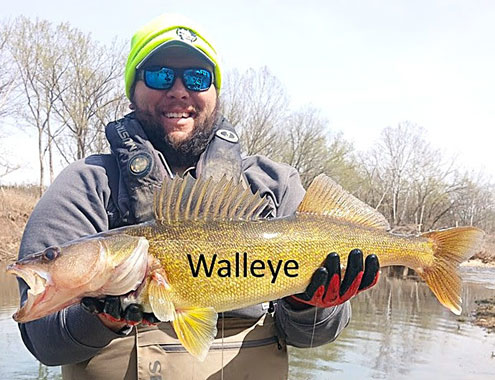
Their habits differ, too. Walleye prefer deeper, cooler water with rocky bottoms, while sauger tolerate warmer and more turbid water and softer substrates like mud or sand.
Because the two species are so closely related, they can interbreed, producing a hybrid known as a saugeye. A saugeye will often display the dark blotches of a sauger combined with a faint white tip on the tail like a walleye. All three are excellent table fare and a fun catch for Arkansas anglers, so next time you reel in a golden, toothy fish from a river, take a closer look. Thanks to our Fisheries Division staff in north Arkansas for passing along this information, and the photos that accompany this story, so we can pass it on to Fishing Report readers.
Now go get ’em.