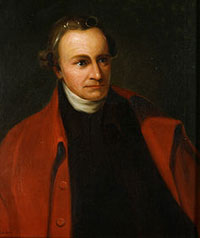
Patrick Henry was born in Virginia in 1736. His father was a Scottish immigrant and planter. He attended local schools until he was 10 until his father hired a tutor for him at home. He worked briefly as a clerk as a teenager and at age 16, briefly owned and operated a small store with his older brother.
At 18, he married Sarah Shelton, and her father gave the newlywed couple 300 acres and six slaves. He also operated a tavern where he began studying law. In 1760, he was admitted to the Virginia bar and opened a practice. In 1765, he was elected to the Virginia House of Burgesses.
As a legislator, he never had a lot of influence. As a speaker in an age of great orators, he quickly soared above the rest. He immediately became a critic of the Stamp Act that the British parliament had imposed on the colonies. In one speech, he loudly condemned the British government in the legislature.
Loyalists jumped up to defend the king, shouting “Treason!”
Without hesitation, Henry shouted back, “If this be treason, make the most of it!”
Months later, the combined efforts of the colonists forced the British to repeal the Stamp Act.
Patrick Henry remained interested in education and building the economy of the state. In 1775, he co-founded Hampden-Sydney College, the tenth founded in the colonies and served on the board of governors. Henry was an outspoken advocate of religious freedom, calling for cooperation between the major denominations. He periodically spoke out against slavery, but he would continue to own slaves for the remainder of his life.
As Parliament continued to impose restrictions on the colonies, Henry continued to speak out, insisting that the rights the colonists had as English citizens were under attack.
“Show me that age and country where the rights and liberties of the people were placed on the sole chance of their rulers being good men, without a consequent loss of liberty?” he declared. “The liberties of a people never were, nor ever will be, secure when the transactions of their rulers may be concealed from them.”
After the Boston Tea Party in December 1773, Parliament had imposed harsh publishments on Boston in response through the Intolerable Acts. This had prompted the colonists to call for the Continental Congress to convene in 1774. In 1775, by the time that fighting erupted between the colonists in Massachusetts and the British, Henry called on all colonists to support the war and independence. In his famous speech, he cried out, “Give me liberty or give me death!”
By 1776, Virginia was at its breaking point and agreed with him. Henry continued to speak passionately for American independence, and the legislature urged Virginia delegates at the Continental Congress in Philadelphia to declare independence. Virginia broke away and formed a new government, swearing in Henry as governor on July 5. He would continue in the position until 1779 when he was succeeded by Thomas Jefferson.
During his time as governor, he faced the difficult steps of leading the state in a time of war while working to recruit troops for the cause of independence and keeping the state functioning. In 1778, he led the successful effort to ban slave importation from Africa into Virginia.
After his terms ended, he returned to the House of Delegates as a representative. In 1784, voters returned him to another term as governor where he called for a system of canals and internal improvements to help trade.
In 1786, he once again returned to the legislature.
When the Constitutional Convention convened in 1787 to draft a new governing document for the nation, Henry was selected as a delegate. Fearing what a new national government could look like under a new constitution and fearing a repeat of Britain’s abuses, Henry declined to participate.
When the debate over ratification of the constitution ensued in the fall of 1787, Henry was an outspoken opponent of ratification, preferring the loose alliance of states under the Articles of Confederation.
In 1790, only 54, he stepped down from the state legislature and retired from politics. He invested in real estate and practiced law, hoping to pay off the many debts he had incurred over the years. He had married in 1777 to Dorothea Dandridge following his first wife’s death, and between his two marriages had 17 children.
Despite his retirement, Henry remained in high demand. When Thomas Jefferson stepped down as secretary of state in 1793, President George Washington offered him the position. Though the two had great respect for one another, Henry declined. Washington also offered to nominate him as a justice on the US Supreme Court in 1794 and as ambassador to Spain. Again, Henry declined both, feeling he was needed by his family more. He died at his home in Virginia in 1799 at age 63.