AgriLife Extension expert explains identification tips, toxicity risks and safe removal methods
Don’t let its delicate white blooms fool you — poison hemlock is highly toxic and can be deadly. Knowing how to identify and control this toxic plant can help you avoid potentially dangerous exposure.
Native to Eurasia, the invasive poison hemlock can be found throughout North America across a variety of environments, ranging from roadside ditches and suburban backyards to rural pastures, said Megan Clayton, Ph.D., Texas A&M AgriLife Extension Service range specialist and professor in the Texas A&M Department of Rangeland, Wildlife and Fisheries Management.
“All parts of the plant are highly toxic to humans and livestock, and can be fatal if ingested,” Clayton said. “It’s important to be aware of the plant and know what characteristics to look for to avoid contact and carefully implement control methods.”
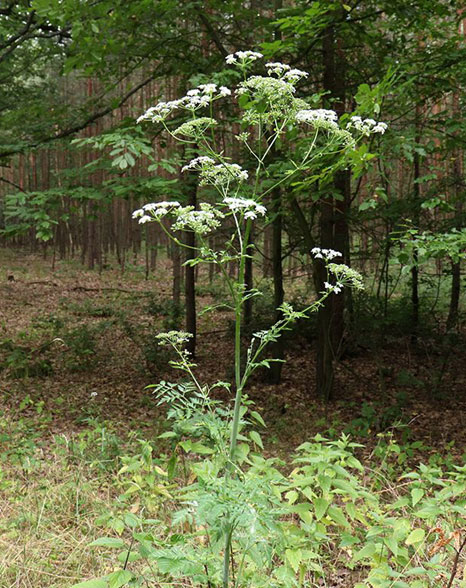
Identifying poison hemlock
A member of the carrot family, poison hemlock looks similar to other plants, including wild carrot and spotted water hemlock, which can make identification difficult.
Clayton said during the first year of plant development, poison hemlock appears as a flat, circular arrangement of leaves on the ground, known as a rosette.
“During the plant’s second summer, it will grow an upright stalk with leaves and flowers, making it more noticeable and easier to identify than the previous rosette stage,” she said.
Identifying features include:
- A smooth, upright stalk that typically ranges 3-4 feet tall, but can grow up to 10 feet.
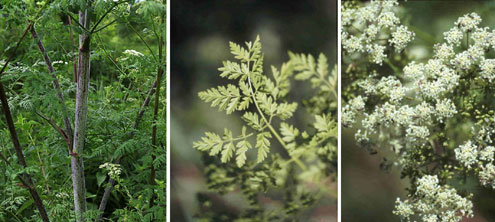
- Distinct purple streaks or splotches along the stalk.
- Umbrella-shaped clusters of small, white flowers at the end of branches that generally bloom from May through August.
- Large, triangular-shaped leaves that are fern-like in appearance.
Because of the plant’s toxic nature, Clayton said it is always recommended to seek identification from an expert, such as your AgriLife Extension county agent. Avoid contact with any plant you suspect may be poison hemlock.
Exposure symptoms in humans and livestock
Symptoms of poison hemlock exposure can appear quickly in humans and livestock.
Typically, poison hemlock is only fatal if ingested. However, poisoning can occur through skin contact or by inhaling its fumes. For this reason, Clayton does not recommend burning or mowing over plants, as it can release the toxic compounds into the air.
“Contact can cause severe skin inflammation,” Clayton said. “It is also possible for the toxins to enter the bloodstream through cuts or mucus membranes in your nose, eyes or mouth.”
Individuals who suspect they have been exposed to poison hemlock should seek emergency medical care immediately.
Signs of human exposure include:
- Skin irritation.
- Sweating.
- Vomiting.
- Dilated pupils.
- Trembling, dizziness and slowed heartbeat.
Typically, livestock avoid directly foraging on poison hemlock when adequate feed and forage options are available, Clayton said. However, if poison hemlock is inadvertently cut and baled with hay, the danger of ingestion is very high.
“It becomes pretty nondescript once it is dried and baled in with hay,” Clayton said. “That’s a real threat, because the animal isn’t going to notice it at that point.”
Signs of livestock exposure include:
- Muscle tremors and nervousness.
- Salivation.
- Loss of coordination.
- Slowed heart and respiration rate.
- Paralysis.
Clayton said a pregnant animal that ingests small amounts of the plant can result in young born with birth defects, including skeletal deformities and cleft palate.
If livestock exposure is suspected, veterinary care should be sought as soon as possible.
Control and management of poison hemlock
Once the plant is identified, Clayton said there are a couple of options for safe removal.
“It can be manually removed by carefully pulling up the plant, including its taproot, or through application of an herbicide,” she said.
In both cases, Clayton stresses the importance of wearing clothing and gloves to cover the skin, as well as personal protective gear like a mask and eye protection.
Clayton recommends removing livestock or fencing off areas that contain poison hemlock, especially when applying herbicide treatment.
“There are some indications that herbicide actually breaks down the plant, making it more palatable to livestock while still maintaining its extreme toxicity,” she said.
Once the plant is present, it is important to establish ongoing monitoring for reemergence — especially if the area is used to bale hay.
Encouraging awareness and knowledge over fear
While awareness is important, Clayton said she doesn’t want concerns about toxic plants to keep people from exploring the outdoors and enjoying the state’s diverse plant life.
“The vast majority of plants in our state won’t hurt you from a simple encounter,” Clayton said. “Improving your plant identification skills and having a working knowledge of those plants you may want to steer clear of can help alleviate anxiety and grow your appreciation for our state’s diverse flora.”