This past week, Cedar Creek guide Chris Webb, Jeff Rice and I met at the boat ramp just as the sun was beginning to light up the eastern sky. Our goal was to film a segment of our weekly TV show, “A Sportsmans Life” and glean information on catching summer crappie to share with you here. Our plan was to get in on a very dependable early morning bite and then get off the water before the Texas sun got too high overhead, and this we did. Let me tell you all about how we boated a cooler full of nice-sized crappie that were on a dependable bite that Chris expects to hold throughout the summer.
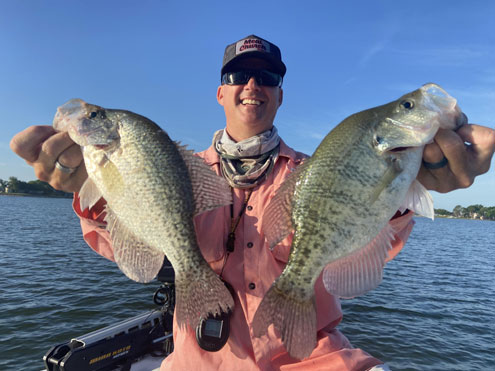
On the phone the evening before, Chris said with confidence that we should have no trouble catching a nice box of crappie during the first few hours of daylight.
“We should have our fish caught and be heading to the dock by nine,” Chris predicted. “We will be in the shade cleaning fish before the temperature begins to soar."
Regardless of which the lake one fishes, crappie patterns remain much the same. During the spring, there is the shallow water bite that everyone gets excited about. Granted, it is great fun catching shallow-water fish under a floater but as every crappie angler knows, catching is often feast or famine especially during early spring when fish are moving in and out of the shallows.
Once the spawners lock down in shallow water to procreate, fishing can be very dependable. This past spring I joined Chris for some shallow-water creek fishing on a feeder creek above Cedar Creek and catching was about as good as it gets. Once the fish transition from shallow to deep, usually around the end of May, fishing becomes as dependable as the Polar Star.
The trick now is fishing brush piles or lay-down logs in water fifteen- to twenty-feet deep and the bite is usually best within a couple feet of bottom. This heavy cover attracts all sorts of baitfish and crappie move in for easy picking. Bridge columns can also be productive; the algae on the columns attract the bait and you will find crappie where their food source is most plentiful.
Our first spot to fish was a big, submerged tree with plenty of fish-attracting limbs in water 17-feet deep, the tree marked clearly on the forward-facing sonar. There was a cloud of baitfish, probably shad all around the limbs, and below the bait, the screen plotted several bigger inverted V’s. These, Chris pointed out, were the barndoor crappie we were targeting, all were very close to bottom.
Technique is very important in summertime crappie fishing. We were using medium-action spinning rods with very sensitive tips, gold crappie hooks and live minnows.
“If you wait for a definitive 'strike,' you won’t catch a single fish," instructed our guide as we lowered our baits to bottom. "These fish will simply suck the bait in. You might feel a very gentle tug but more than likely, there will just be a heavy feel as the fish grabs the bait and loads up your line. It’s important to keep in constant contact with your bait, even on the fall. If your line goes slack, lift up quickly and set the hook.“
This finesse fishing requires a bit of getting used to, but once you learn to set the hook when anything feels different or when the line goes slack, you are well on your way to becoming a finesse fisherman! I’ll be the first to admit, I am much more experienced in a catfish hammering my bait hard or the ‘thump’ of a white bass as he nails my slab on a hot summer day, but I soon adjusted to the soft bite and began getting the hook set.
My buddy Jeff was quick to pick up on the subtle crappie bites and after about thirty minutes of fishing, the bottom of the cooler was filled with tasty crappie. It was then time to take our training wheels off! We were fully trained, locked and loaded and began hooking crappie with regularity.
There is no way to determine, by the bite, what size crappie has grabbed your minnow. I had some undersize crappie hit the bait harder than some of the bigger slabs that I landed. The drill is to keep the rod tip low, about a foot up from the water and pop the rod up hard the instant you feel a bite or see your line go slack. Crappie aren't the only fish that enjoy chowing down on a lively minnow and we caught several catfish and tasty yellow bass. Our goal was a couple of big fish fries and we weren’t the lease bit opposed to adding a few more fillets to our skillets of crispy crappie fillets.
Choosing the right tackle is most important when fishing these soft biting fish. I would shy away from short ultra-light rods. You need the leverage of a longer rod to get that hook set on a long, upward swing. It’s important to use just enough weight to keep your minnow somewhat anchored in place rather than allowing it to swim around and tangle your line in the heavy cover. The gold Aberdeen hooks bend easily. I don’t remember us losing one to the tangle of limbs and brush below the boat. We did become snagged in the cover occasionally but a steady pull on the line was all it took to pull the hook free.
Chris, like most every guide I’ve fished with the past couple years, uses a forward-facing sonar but mostly as a way to pinpoint fish. Granted, with this state-of-the-art sonar, it’s possible to put the bait right in front of the fishes mouth but I simply detest this type of fishing. Catching fish in this manner is much like playing a video game and, to be honest, it takes away from my concentration.
Oh, I have been taught the concept of first seeing the fish on sonar and then watching my bait fall to just above, but it seems the millisecond between me watching the fish hit the bait on the screen and then reacting and setting the hook always causes me to loose more fish than I catch.
I like the way Chris used the advanced sonar to see the fish and then advise as to how deep to place baits. I get it -- it’s possible to target individual fish when one keeps glued to the screen -- but for me, it’s much more fun and productive to keep an index finger under that line just above the reel and ‘feel’ the bite.
Chris expects this summer pattern to continue until the first cool fronts blow in, usually in late September or October. There will then be a transition period as crappie move from their summer haunts in deep water to mid-range depths until finally they move back to deep water where the winter bite is much like the summer pattern. But for now, brush, deep water and live minnows is the ticket to a big cooler of tasty crappie and oh yes, a quick hook set, often on a slack line!
Listen to Guide Chris Webb talk crappie catching on Luke’s radio show/podcast “Catfish Radio with Luke Clayton and Friends. Chris can be reached at 903-275-3253. Email Luke through his website www.catfishradio.org