It’s summertime and fishing is easy. Maybe I should write the ‘catching’ is easy, for both blue and channel catfish. I just got off the water at Lake Tawakoni with guide Tony Pennebaker and Jeff Rice who produces and is the primary force that drives our weekly TV show “A Sportsman’s Life”. Our primary goal was to catch a box of ‘eater’ blue catfish and then switch to some fast-paced action on the smaller but scrappy channel cats. We accomplished both on one of those cloudy mornings last week.
There was just enough wind to put a little chop on the water, which is always a good thing. Wind not only makes fishing more pleasant for the fisherman but it also makes the fish bite better. Why? Well, there are many answers to this age-old question. I believe fish are less spooky when the surface is dimpled with wave action. It’s just my guess but I do know fishing is always best when there is a little wind. There was a little chop on the water and the fishing could not have been better.
We launched Tony’s big comfortable pontoon boat at the break of day, our plan was to use cut shad in shallow water and boat a cooler full of tasty blue catfish and then head back to Tony’s dock and use his Tony P’s punch bait to round out the morning in the shade of the covered dock on feisty channel cats.
There are many misconceptions about catching blue catfish. Granted, the cool weather months are always best for catching numbers of big trophy class blues but fishing can be really good this time of year for smaller blues with the very real possibility of catching a trophy class fish or two.
As a general rule, blue catfish are bigger on average than channel catfish. Most channel catfish weigh between one and three pounds but it’s common to catch blues ranging from five pounds up to trophy class. A box of blues weighing between five and ten pounds is pretty common and this equates to several pounds of very tasty boneless snow-white fillets.
Blues first
Catfish are not always deep during the summer months and right now, before the thermocline sets in and the water temperature heats up, fishing is best in relatively shallow water. Tony deployed the power poles on his boat in water about 5-feet deep. We were positioned a long cast from a thick matt of lily pads. Six rods were baited with fresh cut shad and baits were soon setting close to bottom with Santee Rigs. These rigs became popular at Santee Cooper Lake years ago and are deadly for catching blue catfish. Basically, a Carolina rig with a floater positioned up from the hook/bait, they keep baits suspended up from bottom which I believe makes it easier for catfish to locate.
Circle hooks are best for this type fishing. Rods are placed in rod holders and when a fish picks up the bait and swims away, the corkscrew shaped hooks twist into the corner of the fishes mouth. There is no need for a strong hookset when using circle hooks but Pennebaker does suggest putting pressure on the rod to insure the hook is set.
On our first anchor we landed several nice blues weighing between two and eight pounds. After an hour or so of fishing the action slowed and we moved to water a couple feet deeper in an area between two large stands of lily pads. Tony pointed out that the catfish use this open water as a runway to move from shallow to deeper water as the morning progresses. Here we added several more good eaters to the box including the largest of the day that weighed about 12 pounds.
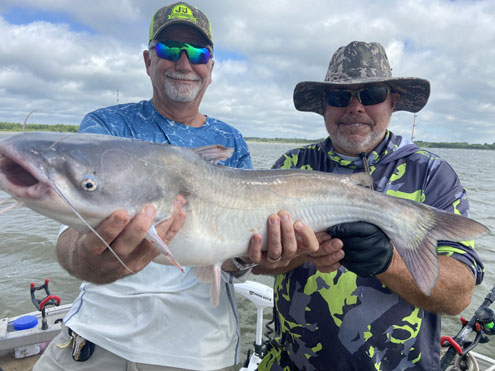
At times, the blues slammed the baits and the rods bent heavily and other times the bite was soft with only a twitch of the rod tip as a clue. The drill was simple, when we thought a fish might have the bait with the rod still in the rod holder, crank like crazy on the reel to put tension on the fish and then pull the rod out and lean back on it to make sure of a good hookset.
When this bite slowed, we went to water just a bit deeper, around 8 feet deep. This was a spot void of lily pads, just open water where Tony had been catching a lot of fish. What made this area better I do not know but observant fishermen that fish on a regular basis learn areas that consistently produce. Here we proceeded to put a few more blues on ice. The sun was beginning to heat things up and it was time to head for the shade of Tony’s dock and do a bit of punch bait fishing for channel catfish.
"I’ve got these fish trained," kidded Tony as we baited #6 treble hooks with his Tony P’s punch bait.
Tony explained that this is the spot where he cleans his clients catch and the channel catfish stay under the shaded dock and around the shoreline lily pads and move in to feed the moment he begins using his electric knife.
“Go ahead and get your baits I the water...you might catch a couple early, but once the electric knife begins buzzing and the trimmings hitting the water, the action will be nonstop,” says Tony as we position our floaters about 2 feet above the baits.
He was not wrong! While Tony was transforming those blues into what became four one-gallon bags of fillets, Jeff and I enjoyed some fast-paced catching on channel catfish up to about 3 pounds.
We left with the makings of a couple very big Fourth of July fish fries and the memory of a great time on the water.
Guide Tony Pennebaker can be reached at 903-474-3078. He’s rigged and ready to put you on a big “mess” of blue or channel catfish…. or both!
Check out Luke’s weekly podcast “Catfish Radio with Luke Clayton and Friends” just about everywhere podcasts are found. Email Luke through his website www.catfishradio.org