I remember well my first experience feeding deer in hopes of attracting them to my hunting blind which, back in the sixties, was a couple of two-by-fours nailed to the fork in a tree branch of an old oak. My uncle was pretty handy with working metal, and he had fashioned a couple of gravity-flow deer feeders from sheet metal.
“Boy,” says uncle, "we will nail these to a tree near our stand, fill them with corn and have every deer in the woods coming to our hunting spots.”
I’m sure we did attract a few deer but the problem was raccoons, squirrels, birds and just about every other form of wildlife native to East Texas; everything, including the deer we hoped to attract, loved corn. I don’t ever remember checking our makeshift feeders when they held any corn. Back then we didn’t have trail cameras to monitor exactly what was eating our corn, but it never lasted long.
And then back in the early seventies we began using electric feeders with mechanical timers. Pins were pushed into a wheel which was hooked to a battery-powered clock. When the wheel turned to the time we set the pin, a contact was triggered and the feeder spun and corn was distributed...sometimes!
These early timers were very unreliable and even back then I knew there had to be a better way. Then along came the early programmable timers that came with feeders equipped with tiny motors that were notorious for ‘going out’ when exposed to a summer of scorching Texas heat. I remember reading instructions that required an electrical degree to program these early feeders. They worked sometimes but were anything but dependable.
In the late seventies Dan Moultrie invented the first automatic photocell feeder. I remember using some of these early units that broadcast corn just after sunup and again before dark, they were a huge improvement, but varying factors such as cloud cover and shade made the photocell feeder less than 100 percent reliable.
I first met Karl Harmon back in the nineties. This was when modern state-of-the-art game feeders became popular and were readily available. Karl owns Ultramatic Feeders in Hockley, Texas, which is a one-spot shop for everything to do with hunting blinds and game feeders. Karl is a mechanical type guy and a behind the scenes inventor of many useful hunting products. I remember several years ago at a hunting show when Karl introduced me to some products that I have been using ever since.
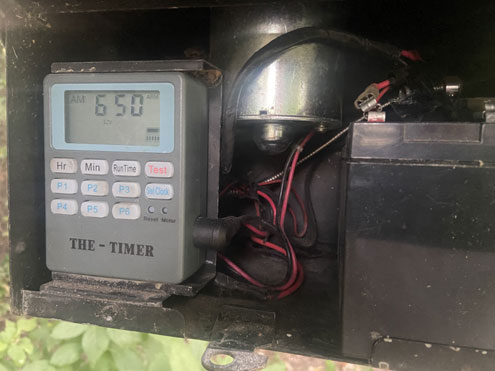
Previously, I was challenged with setting the feeding times on timers, most were complicated and unreliable. He showed me the then newly invented “The Timer”. Operation of the unit was straightforward and after watching Karl demonstrate the simplicity of the unit, I was able to set multiple feeding times by using the up and down buttons that controlled the current time and the times I wished the feeder to distribute corn. Through the years, I have tested several different models but for my own feeders, I use only The Timer. I have never had one fail and found them to hold up well to the hot Texas summers; they just keep on ticking!
Karl also introduced me to “The Remote” which is a device that remotely triggers the feeder to distribute corn. The premise is simple, when game eats all the corn under the feeder, with the touch of a button on The Remote, there is a fresh supply of feed on the ground. I’ve found on many occasions the sound of the feeder spinning attracts animals that have associated the spinning of the feeder with food.
Most quality feeders today are powered by dependable heavy-duty motors with quarter-inch shafts and lithium batteries are quickly becoming the norm. They cost more than lead cell batteries but last much longer.
Another great invention that I have on my feeders is a spinner plate called “The Eliminator”. This unit mounts to the quarter-inch shaft from the motor. It works on centrifugal force, when the motor spins, the unit drops down allowing corn to freely flow from the downspout. When the motor shuts off and the shaft stops spinning the Eliminator rises and tightly seals the flow of corn. This seals the downspout opening from raccoons, squirrels and birds which also saves the hunter dollars in spilled or wasted corn.
Hunters often live two to four hours from their hunting lease and innovations such as these insure their feeder is operational during the summer months when they are often not spending a lot of time on their lease.
Quality game feeders rigged and ready to go are not cheap but there are options that work well and save money. Self-contained units are available that mount to the bottom of barrels. They are that quick and easy to mount. These units have The Timer and motor housed in a durable metal box with a solar panel attached. The hunter need only push the downspout through the bottom of the barrel and mount the under the feeder with screws.
I have a couple of these units at work close to home, one is a 33-gallon metal drum and the other mounted on a 55-gallon barrel. These self-contained units are a good option for someone that has the desire to save money using economically priced metal barrels. A bit of welding and an old oil drum can be converted to a very serviceable game feeder.
Soured or caked corn in the bottom of a feeder used to be a real problem and still is without the use of metal cones placed in the bottom of the feeders. These cones funnel all the grain down into the downspout. Without funnels, much of the grain is on either side of the hole in the center of the barrel and over times, it absorbs moisture and the feed becomes wet and caked.
Yep, there have been many awesome innovations in the way we hunters feed game. Now we can simply set the times when we wish to feed, fill the feeder with corn and rest assured the feeder will work properly until out next visit to the lease.
Listen to Luke’s weekly podcast “Catfish Radio with Luke Clayton and Friends” just about everywhere podcasts are found. The current show can also been heard or radio stations across the state on weekends or online at www.catfishradio.org