The nation's first presidential election in 1788 produced no surprises. George Washington was elected unanimously. Though not required by the Constitution, Washington chose a board of three advisors, his cabinet, to advise him. To get the nation working on a paying basis, the choice was obvious, his trusted old friend Alexander Hamilton of New York.
In 1789, President George Washington appointed Hamilton, already a successful lawyer, banker, and veteran as the first Secretary of the Treasury. He came in with many bold ideas. However, he soon clashed with the new Secretary of State Thomas Jefferson. His plans for the federal government combined with his animated self-confidence and intelligence bristled against Jefferson and his more reserved but equally intelligent nature.
Hamilton made his first priority to develop a system of revenue to keep the government financially viable.
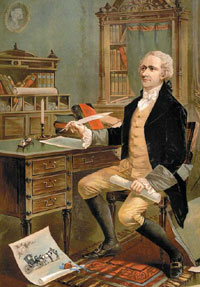
Eventually, many of his ideas were adopted, which led to the creation of U. S. Savings Bonds. He convinced Congress to establish the U. S. Mint in 1791. Hamilton wanted a nation that was economically self-sufficient and foresaw an urbanized and technological future for the nation.
Contrarily, Jefferson foresaw America as a nation of farmers who worked for themselves rather than investors. To help gain support for his ideas, Jefferson and Hamilton made another agreement that changed the nation – they agreed that the nation’s capital would move from New York City to a new, centralized city on the Potomac River, which became Washington, DC.
His disputes with Jefferson led to the creation of the first political parties in the U. S. Hamilton resigned from the treasury in 1794. In the 1796 election, he disagreed sharply with both presidential candidates Thomas Jefferson and John Adams. He attempted to interfere with Adams’s candidacy, leading to Adams winning narrowly and Jefferson becoming vice-president. Adams, unhappy with Hamilton, locked him out of the government. Hamilton’s standing took a hit with revelations of an extramarital affair.
Still determined to have a voice in the political debates, in 1801, Hamilton and a number of other prominent opponents of Jefferson met to discuss founding a newspaper. The meeting took place at the home of Scottish immigrant and businessman Archibald Gracie, whose home, Gracie Mansion, is now the official residence of New York City mayors. The paper, The New-York Evening Post, has been printed for more than 200 years and is today The New York Post.
In 1804, Aaron Burr ran for governor of New York. He lost by a wide margin. Hamilton, who had long been a political rival and had seen Burr replace his father-in-law Philip Schuyler in the Senate, had written a number of pamphlets questioning Burr’s suitability for office. Burr was enraged by Hamilton’s remarks, blamed him for his defeat, and challenged him to a duel.
Since dueling, then a serious social problem, was already illegal in New York, the two rivals took their fight across the Hudson River into New Jersey. It was nearly the same spot where Hamilton’s eldest son died at age 19 in a duel in 1801, again over disputes over his father’s politics. Who fired first is still in dispute, and both families still allege the other came with dishonorable intentions.
Nevertheless, in the early morning hours of a July day, the Vice-President of the United States and the former Secretary of the Treasury faced off in a fight to the death. They faced off with the standard single-shot .54 caliber pistols. Hamilton’s shot went over Burr’s head and into the trees, while Burr’s shot slammed Hamilton square in the abdomen. Hamilton was brought back to his home where he died the next day, not even 50 years old.
Burr found his career over and reputation in disgrace, but he never stood trial for the death of Hamilton. Hamilton’s wife Elizabeth would outlive him by 50 years, dying at age 97 in 1854. She raised their remaining children and became active in many charity works, including raising money to build the Washington Monument and co-founded the New York Orphan Asylum Society, caring for hundreds of children.
Hamilton himself was honored with schools, counties, and streets named for him. In 1929, his face was put on the $10 bill. His reputation underwent a renewal with the premiere of the popular Broadway musical Hamilton in 2015, much to the appreciation of his descendants. Perhaps his most significant legacy was the framework for the federal government finance system still in use today, and his words from The Federalist are still quoted in debates over constitutional law.