As summer wanes, putting the garden to 'bed' for the winter begins to occupy our thoughts. Our goals may include cleaning up and tidying our garden beds. Raking up all the detritus and bagging it for removal is often our go-to practice. However, if we don’t want to send all that organic matter to the landfill, or add it to our compost pile, we can leave it in place and nurture the life cycle of native bees.
So, why should we nurture the native bees? We are well aware that honeybees are pollinators–and produce that delectable by-product, honey! Mason bees are pollinators, too. At risk of maligning honeybees, which only pollinate about 5% of the flowers they visit, mason bees pollinate up to 95% of the blossoms they touch, thanks to their hairy bodies that drop loose pollen on all the flowers.
Unlike the honeybee who carries pollen on their back legs, the mason bee carries pollen on their scopa, a dense patch of specialized, branched hairs located on the underside of the female's abdomen. Commonly known as belly flopping, the female mason bee bumps into the pollen when she lands on a plant. This pollen is easily transferred to other plants during her foraging forays.
Mason bees flit and fly only 300 feet from their nest; so, placement of food sources and nesting cavities is a critical consideration. Mason bee cocoons can be purchased and their release staggered so pollination of fruit is maximized. They co-exist with honeybees and help reduce the stressful demand placed on honeybee colonies.
What is the mason bee?
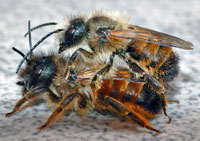
Mason bees overwinter in hollow stems of plants or in abandoned holes drilled into wood by beetles, or in man-made structures (wood blocks). The ideal nest cavity for common mason bees (like the blue orchard bee) measures 5/16 inch in diameter and 6 inches deep, with a securely closed back. They are active for 4-6 weeks in the early spring once temperatures consistently reach 55 degrees Fahrenheit (typically late February to early March).
The life cycle of a mason bee takes about a year. During the 4–6-week active period in early spring, adult bees chew their way out of their winter cocoon. Male bees emerge first from the front of the cavity. Female eggs, which were strategically laid toward the back of the cavity, emerge a few days later. The smaller male piggy backs on the female during mating, and lives just a couple of weeks. The female spends the rest of her 6 weeks of life laying eggs in available cavities. Adult mason bees will not survive once temperatures reach 75 degrees Fahrenheit (typically late March to mid-April).
The female creates several chambers in the nesting cavity. The back of the tunnel is packed with a mixture of pollen and nectar before she lays a single egg on the pollen (bee bread). She then builds a thin mud wall partition and repeats this cell-stacking process. When the tube/tunnel/cavity is full, she seals the outer end with a thick mud plug. Females control the sex of their offspring. She lays the fertilized eggs toward the back of the cavity (which will become females) and lays unfertilized eggs in the front of the cavity. Common wisdom regarding this practice says the mother bee is protecting the female eggs from woodpeckers and other predators. Any female bee who has not mated will lay unfertilized eggs. A single female will lay about 15 to 20 eggs in her short lifespan.
Once the cell is complete, a marvelous change begins! Inside the cavity, the egg hatches into larva within 7 days. During the next 4-6 weeks the larva eat the bee bread, growing and molting through multiple stages. By late summer the fully grown larva spins a waterproof silk cocoon inside its mud cell. The larva enters the pupa stage and transforms into an adult bee. The fully developed adult bee rests inside the cocoon through the fall and winter (a dormant state known as diapause, pronounced DY-uh-pawz). To survive the cold, the adult bee metabolizes internal fat reserves until the spring temperatures reach the necessary 55 degrees Fahrenheit.
How do we nurture mason bees?
Since mason bees emerge early in the spring, we can nurture them by providing food sources. According to the Lady Bird Johnson Wildflower Center, plants that are good sources of nectar and/or pollen include: Phacelia congesta, native salvias, redbud trees, coneflowers, American Red Columbine, bee balm (Monarda species), purple coneflower (Echinacea purpurea), Slender Mountain Mint (Pycnanthemum tenuifolium), Sunflower (Helianthus species), elderberry (Sambuca), joe-pye weed (Eutrochium), raspberry (Rubus), and bluebonnet (Lupinus texensis). For those of us who have orchards, cover crops are beneficial and mason bees thrive on clover and vetch.
Since mason bees are cavity-nesting insects, we can nurture them by providing nesting materials. Many of their food sources can become nesting cavities because they have hollow stems. Some plants in this category include bee balm, purple coneflower, Mountain Mint, Sunflower, elderberry, joe-pye weed, and raspberry. When tidying up garden beds, we can cut back dead flower stalks from 8 to 24 inches in height and leave the stem stubble which may become nest cavities. We can also leave some dead wood that has holes drilled by beetles. Place this dead wood in a south-facing area protected from wind and rain. Since mulch obscures the ground, we can leave some unmulched areas so the mason bees have access to mud for their nest building. We can provide a small, wet patch of clay-rich soil nearby, as female mason bees require mud to seal their nesting tubes.
If we wish to provide mason bees’ nest using wood blocks, we can purchase them. If you purchase wood blocks, be keenly aware that they require annual cleaning and sanitizing. Mason bees are susceptible to tiny parasitic mono wasps (Monodontomerus), Houdini flies (Cacoxenus indagator), hairy-footed pollen mites (Chaetodactylus krombeini) and fungal diseases (chalkbrood). The wood blocks create a colony situation for bees that are solitary and give rise to the population of parasites that destroy them.
I am fascinated by these pollinators! As I improve my gardening practices, I will give space to nurturing them by incorporating native plants which provide food and nesting habitat.
As a Fannin County Master Gardener, I extend a hearty thank you to our 2026 Sponsors: Dadant Beekeeping Supplies-Paris; 160 Lawn and Timber-Whitewright; Community National Bank & Trust-Bonham; First United Bank-Bonham; Legend Bank-Bonham; The Nursery-Double O Seven Farms- Telephone; Red Coop Feed and Seed-Bonham; Stay Grounded Coffee Cafe-Bonham; Twin Oaks Nursery-Denison; Texas Farm Bureau Insurance-Fannin County; and Fannin County Soil and Water Conservation District.
RESOURCES
https://extension.oregonstate.edu/catalog/pub/em-9130-nurturing-mason-bees-your-backyard-western-oregon
https://www.fs.usda.gov/wildflowers/pollinators/pollinator-of-the-month/mason_bees.shtml#:~:text=(Osmia%20lignaria).-,Blue%20orchard%20mason%20bee%20(Osmia%20lignaria).,also%20known%20as%20orchard%20bees
https://landmarkwildlife.com/all-the-buzz-keeping-mason-bees-in-texas/
https://citybugs.tamu.edu/2021/06/17/the-native-mason-bee/
https://extension.psu.edu/orchard-pollination-solitary-mason-bees
https://xerces.org/pollinator-conservation/nesting-resources
https://www.ars.usda.gov/ARSUserFiles/20800500/Bosch2001.pdf
Texas A&M AgriLife Extension Service provides equal opportunities in its programs and employment to all persons, regardless of race, color, sex, religion, national origin, disability, age, genetic information, veteran status, sexual orientation, or gender identity. The Texas A&M University System, U.S. Department of Agriculture, and the County Commissioners Courts of Texas Cooperating.