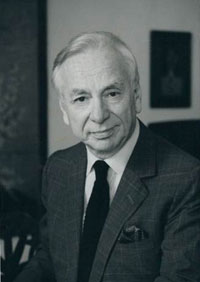
Vincent is remembered for his work that helped shape the Dallas skyline we know today, developing buildings such as One Dallas Centre, One Main Place and One Energy Square. He was also a leading figure in civic, cultural and educational institutions in Dallas and abroad.
Born on Jan. 15, 1925, in New York City, Vincent was the son of Italian immigrant parents Barbara De Luca and Rocco Carrozza. Vincent was a product of New York City’s public schools, graduating in 1942. Earlier that year, he won the Gold Medal competition at the annual public speaking event sponsored by the Long Island Kiwanis Club. In addition to Italian, he learned German and French taking subways to sessions after school, which would later be of use in his service during WWII. He entered Columbia University in January 1943 and two months later was inducted into the U.S. Army Infantry.
Vincent served in Patton's Third Army as it thrust into Germany in the Saar Valley, where his unit, the 259th Infantry, suffered very heavy casualties in attempting to breach the concrete pillboxes of the Siegfried Line. While serving as a combat infantry platoon sergeant, his unit crossed the Rhine at Mainz, the Danube below Regensburg and advanced farther east than any other U.S. military unit.
In early May 1945, while German forces were surrendering in other European sectors, Vincent's battalion was confronted by an SS regiment that refused to surrender unless the Americans joined them in fighting the advancing Russian forces. Speaking German, Sgt. Carrozza engaged in surrender negotiations.
As these negotiations continued over two weeks, Vincent led his squad to explore the area. On a road east of Linz, Austria, the squad came upon the German headquarter camp, which along with a large number of sub camps was known as the Mauthausen Concentration Camp. The camp provided slave labor for the Hermann Göring Tank Works.
Vincent’s squad found a barbed wire enclosure containing hundreds of the most wretched Russian prisoners, some in their teens and others very old, barely clothed and emaciated. Adjoining barracks housed hundreds of Italian and French prisoners, of both genders and of various ages. It was an experience that stayed with Vincent for the rest of his life.
The prisoners were guarded by the German Home Guard, middle-aged and older conscripts who readily surrendered. One of them, an SS officer accused of the most heinous crimes, later took a cyanide pill. On May 5, the 41st Allied Reconnaissance Unit of the Third Army disarmed and liberated the sub camps.
The official U.S. Army records concerning the liberation of the Mauthausen Concentration Camp credit the Reconnaissance Unit with the liberation of all the sub camps including headquarters camp. No mention is made of the role Vincent’s squad played in first liberating the main camp. The Bronze Star along with other decorations and citations were presented to Vincent for his World War II Service.
In January 1946, he returned to Columbia University, graduating in 1949, when he was awarded the Richard H. Fox Memorial Prize at graduation ceremonies, given to the graduate “who demonstrated leadership through positive team contributions, dependable action and consistent hard work leaving a lasting impact on the College.”
He began his post-college career as a newspaper reporter for The Atlanta Journal-Constitution and The Dallas Times Herald, before working as director of public relations for Republic National Bank of Dallas.
In 1952, during the Korean conflict, he re-enlisted in the Air Force and was stationed in Alaska in charge of the Armed Forces Radio and Television Service for Northern Alaska, which at that time was occupied by numerous Army and Air Force listening stations as part of the Cold War readiness.
At the conclusion of his military service, he joined the Midnight Broadcasting Co. in Fairbanks (KFRR) as a morning disc jockey and announcer before becoming program manager for the network as General Manager.
In 1955, Vincent was asked to direct the Alaska Statehood Committee’s program for informing the people of Alaska about the proposed Constitution and ordinances of the Constitutional Convention prior to the vote for ratification. Following a tough fight, Statehood was granted by the U.S. Congress on Jan. 3, 1959.
When Vincent and his family returned to Dallas in 1958, he established a commercial and political public relations firm. Together with Phil Fox, who had managed Lyndon B. Johnson's initial Senate campaign, they worked on the Citizen's Charter and Robert L. Thornton's successful mayoral race against Earle Cabell.
In 1962, Vincent joined the Murchison-Overton group in the acquisition, planning, construction and leasing of 10 acres in downtown Dallas. The result was the development of the 34-story One Main Place, a highly successful project with a million square feet of office space plus 100,000 square feet earmarked for retail. Vincent’s role was property management, planning, project relations and leasing. The building, designed by Skidmore Owings & Merrill with collaborator Harwood K. Smith, was completed in 1968 and now houses The Westin Dallas Downtown hotel and conference center.
In 1964, he acquired a 40-acre tract from The Dallas Morning News and Cotton Belt Railroad. The property was later sold to Wes Grogan Partnership and is now the site of the Kay Bailey Hutchison Convention Center and the Omni Dallas Hotel.
In the late 1960s, Vincent established his own real estate enterprise, Carrozza Investments, developing more than 4,000,000 square feet of high-rise office space over the next three decades.
One Main Tower, a 25-story office building with ground-floor retail directly across the street from One Main Place, was developed in a joint venture with Unit, Inc., Vincent and Russell Kibbe in 1972. The building was renovated into condos and is now known as The Metropolitan.
In 1974, Vincent was part of a joint venture with DeGolyer and MacNaughton that developed One Energy Square, a 14-story office building with ground-floor retail space that is now the centerpiece of the Energy Square complex on Greenville Avenue at University Boulevard in Dallas.
One Dallas Centre was designed by architect I.M. Pei & Partners. Vincent developed the 30-story office building, which was part of a planned three-building project, but the remaining phases were never completed. One Dallas Centre opened in 1978.
But Dallas’ wasn’t the only skyline shaped in part by Vincent. He spent the early ’80s working on Oklahoma City high-rises, developing the 19-story Mid America Tower (now known as the Continental Oil Center; designed by Morris Aubrey) in 1980; the 14-story First American Tower (now called Corporate Tower; designed by I.M. Pei & Partners) in 1980; and the 31-story First Oklahoma Tower (now called Oklahoma Tower; designed by Morris Aubrey) in 1982.
In addition to his accomplishments as a developer, Vincent was also a leading figure in civic, cultural and educational organizations in Dallas and beyond.
Over the years, Vincent was a member of Mayor Eric Johnson’s Goals for Dallas, the Dallas Area Rapid Transit (DART) Blue Ribbon Committee, founding director and board member of Theatre Three, and on the boards of Dallas Symphony, Dallas Civic Opera and Hockaday School. He was a trustee of Dallas Museum of Art for 20 years and served as chairman of the building committee during the building's Arts District construction and subsequently as its President.
In Santa Fe, New Mexico, where he maintained a second home, he was vice chairman of the board of St. John's College and a member of the boards of Santa Fe Opera, Santa Fe Chamber Music, Bandelier Fellows of the School of American Research and the Georgia O'Keeffe Foundation.
In addition, he served on several National boards: National Institute of Aging, Alzheimer's Disease and Related Disorders, Regional Selection Board for White House Fellowships, World Council member of International House (New York), the National Committee for U.S.-China Relations and Mutual of New York’s real estate investment trust.
He was a trustee of Columbia University, founding member Board of Overseers, Columbia College, and a recipient of the 1987 Columbia University Gold Medal for alumni service. He was a member of the International Council Tate Gallery (London), on the board and executive committee of the American Academy in Rome and the Italian Academy for Advanced Studies. Vincent was awarded the Order of Merit by the Republic of Italy in 1986.
Vincent enjoyed a variety of social organizations such as the Quo Vadis and Annabel’s in London, Doubles Club and Century Club in New York and the Idlewild Club in Dallas.
Vincent was a remarkable man who lived and led a long and extraordinary life. He was an independent thinker, a voracious reader and student of history and enjoyed hiking and traveling the world. He was an avid outdoorsman who enjoyed organizing in meticulous detail hikes in Europe and the American West, as well as float trips on the Colorado and Missouri rivers. The annual hike along the Continental Divide was one of his favorites.
Throughout his life he continuously reinforced the importance of education and would often credit his Columbia University core curriculum program emphasizing reading, writing, history, the arts and the great Western Civilization classics. He was proud of his Italian heritage and dual citizenship and remained to his final days a terrific Italian cook. His influence on his family and those around him was significant and he will be deeply missed as a profound thinker, always searching for excellence and demanding better outcomes. He cared deeply for his family and never resisted the opportunity to advise.
Vincent was preceded in death by his companion and wife of 70 years, Virginia Anne Reeves. He is survived by three children, Fay Carrozza Martin (John), Lynn Carrozza (Ann) and Bob Carrozza (Taine); five grandchildren Zachary Martin, Jared Martin, Lauren Carrozza Huffines (Sam), Vince Carrozza, and Kyle Carrozza; and two great-grandchildren, Eloise and Gwendolyn Huffines.
The family is grateful for his caregivers, particularly Emily, who remained committed and lovingly attentive, as well as hospice care, David, John and the staff at Edgemere.
A private family service will be held at Sparkman Hillcrest Funeral Home. In lieu of flowers, the family welcomes a donation to the charity of your choice, which would touch Vincent’s heart.