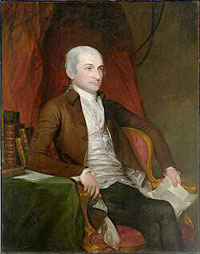
By the 1780s, Jay had already served important roles in the Continental Congress, as a judge, and as a diplomat. He would continue to play an important role as the young republic began to build in the years after winning independence.
After Jay’s return from helping negotiate the Treaty of Paris of 1783, ending the Revolutionary War, Congress asked him to serve as Secretary of Foreign Affairs in 1784. At this point, under the Articles of Confederation, Congress was the only federal governmental body. The position, the forerunner to the modern office of Secretary of State, had him oversee America’s relations with the world.
The government’s finances, however, were a mess. Jay had to manage the nation’s official communications with foreign governments, overseas embassies, and Congress with only two clerks, a handful of messengers and no money.
Seeing the problems that the loose structure of the new national government had, he agreed with others calling for a new constitution. When the Constitutional Convention ended in in 1787, he openly supported ratification. Jay’s support for the Constitution would be essential for its success. He joined with James Madison and Alexander Hamilton in writing The Federalist Papers, a series of 85 essays printed in newspapers in 1787 and 1788 rallying support for ratification. The three wrote the essays anonymously, with Jay writing five of them on his own. New York ratified the Constitution by a narrow margin in 1788. These essays are still widely studied to this day.
After George Washington was inaugurated as the nation’s first president in April 1789, Jay continued to serve as Secretary of State on an interim basis until Thomas Jefferson returned from his duties as ambassador to France later that year.
Congress established the new Supreme Court and the federal court system with passage of the Judiciary Act of 1789. Jay was nominated as Chief Justice by Washington in September 1789 and was confirmed by the Senate two days later.
The Supreme Court at the time consisted of only six justices. In the time since, it has had as many as eleven but has usually been nine justices. They did not meet until 1790, almost a year after the court was formed The court did not actually hear a case until August 1791. The case, West v. Barnes, arose from a dispute over a farm mortgage in Rhode Island and was decided unanimously on procedural grounds.
In its first years, the justices were expected to preside over federal appeals court hearings in distant parts of the country in addition to their own hearings, but they met very rarely. The court had little prestige; and one associate justice, John Rutledge, served for only 18 days before resigning. The Jay court heard only 14 cases.
In 1794, Washington sent Jay to Great Britain to attempt to negotiate a new trade treaty with the British and to try to resolve lingering problems from the Revolutionary War. The British still occupied several forts in the region in spite of the Treaty of Paris. The British, in the midst of a new war with the French, had little interest in negotiations with America. The British reluctantly agreed to leave its Great Lakes forts by 1796 but made the Americans agree not to repair or resupply French ships while its war with France proceeded and agreed to reopen American trade with the British West Indies but under strict conditions.
The British agreed to reparations for some losses for American ships seized while trading with France up to that point. Jay’s Treaty was seen as a disaster for the U. S., and it was barely ratified by the Senate. Protests erupted against the treaty, with Jay burned in effigy across the country.
Jay stepped down from the Supreme Court in 1795. That year, he was elected governor of New York, the second man since independence to hold the position.
As governor, he helped end slavery in the state. However, he had come from a wealthy family of merchants and owned a number of slaves.
At the peak of slavery in New York before the American Revolution, nearly one in seven New Yorkers was held in slavery. Over time, opposition to slavery grew in the state. Jay came to oppose it as well. He co-founded the New York Manumission Society in the 1780s and even served as its president for a year, though in an odd contradiction, he continued to own slaves.
As governor, he signed a gradual emancipation act into law in 1799, freeing all slaves born after July 4, 1799, but only when men reached age 28 and women reached age 25.
“Every man of every color and description has a natural right to freedom,” he wrote and proceeded to free his own slaves.
Slavery officially ended in New York on July 4, 1827.
Jay retired from the governor’s office at the end of his term in 1801. As President John Adams rushed to leave office, he offered him the position of Chief Justice of the Supreme Court once again. Jay, however, declined the nomination and, though only 55, entered into a quiet retirement to his farm in New York. He continued to stay active in civic and church affairs, serving as president of the American Bible Society, which called for distribution of Bibles across the country, from 1821 to 1827.
John Jay died shortly after suffering a stroke in May 1829 at age 83. He was the last surviving member of the First Continental Congress. Since his passing, three schools in New York were named for him as well as a park in Manhattan. Mount John Jay, on the border of Alaska and Canada, was named for him. In honor of his work as a jurist and co-author of The Federalist Papers, the City University of New York renamed its school of criminal justice after him in 1964.