Some hunters come in from a cold sit in a deer stand or duck blind to peanut butter and jelly sandwiches or Vienna sausages with saltines. In a pinch both will suffice, but when time allows and it usually does with a bit of forethought, camp food can be a bit more!
To me, there is nothing tastier at camp than sitting down to a big bowl of venison stew with lots of meat and plenty of veggies. Hot cornbread is an absolute must! This is exactly the meal I prepared last weekend. Very often, rifle hunters have yet to harvest venison early in the season but by the opening of the general season many bowhunters and those hunting managed lands with permits have their freezers stocked. I was fortunate to take a couple of fat doe for the freezer while hunting at the Choctaw Hunting Lodge owned by the Choctaw Nation in southeast Oklahoma.
I cubed up some front shoulder meat which lends itself well to slow cooking with moisture, seasoned it well, dusted it with flour and browned it in my big cast iron Dutch Kettle. Then I added tomatoes, carrots, celery, corn and bell peppers and jalapeno peppers and let it simmer until the meat was fork tender. I used a packet of beef stew seasoning and of course a few ‘extra’ seasonings to add even more flavor.
I prepped most of this at home. With veggies in the cans and fresh ones chopped in a zip lock bag and the meat cubed, seasoned and ready, it didn’t take long to have my stew simmering in the kettle beside the cook fire. Of course, I could have prepared it on a propane stove but there’s something special about cooking with a Dutch kettle over wood coals.
Stew is pretty simple to prepare and every camp cook has his or her favorite recipe but stew without cornbread is like, well… bread without butter! I needed to make some hot cornbread to accompany my stew, and I decided upon ‘hot water cornbread’. I was surprised to learn that many folks have not enjoyed cornbread made this way. I grew up eating conventional oven baked cornbread, but my mother would occasionally make the fried hot water version. It’s really very easy to cook, especially at camp.
There are a few simple steps to follow and your first attempt at this crispy very flavorful cornbread will turn out perfectly. Here’s how I make it, this recipe will make enough cornbread for five or six hungry people. Begin by mixing two cups of cornmeal with about a half cup of flour, a little salt and sugar. I like my fried cornbread crispy, so I add a rounded tablespoon of baking powder, even when using self-rising meal or flour. The ‘rise’ the baking powder makes the cornbread extra crunchy, not tough or chewy but crunchy. You can ‘hear’ the crunch with every bite!
I have a pot of boiling water going and simply pour the water into the cornmeal/flour mix. Pour and stir until the batter is thick but will drop off a spoon into hot oil. The boiling water actually cooks the meal in the bowl and the frying crisps it up. I like to use lard instead of vegetable oil for much of my frying. I honestly believe lard might be better for humans than vegetable oil but that’s another subject. I do know the lard gives the cornbread a great flavor and very little is absorbed into the cornbread when heated to around 350 degrees. I honestly don’t every check temperature when frying. When a little ‘test’ sample of cornmeal sizzles when it heats the lard, the temperature is just right.
I sometime make cornbread ‘patties’ but usually I just drop the meal into the skillet right off the spoon. A heaping tablespoon is about the right amount but if your goal is more flat patties, you will need two or three tablespoons. Just push the meal down into a patty form after you add it to the lard/oil. It won’t be a perfectly formed round piece of fried cornbread but I promise your guests won’t care one they bite into that crunchy goodness! It takes less than two minutes on either side to turn the meal mixture into very crunchy little pieces of cornbread.
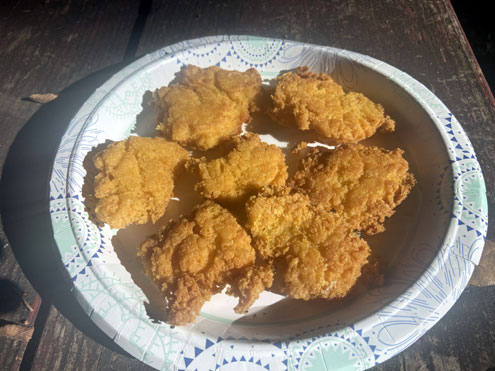
It’s possible to make tasty conventional cornbread at camp in a Dutch Kettle but I always place a metal pan in the bottom of my kettle and set another pan with the cornbread mixture on top. I’ve had zero luck trying to cook cornbread with the mix setting in the bottom of the Dutch kettle, it always scorches regardless how few coals I but under the top. Even when using the pan to elevate the cornbread mix, I go very sparingly with coals under the kettle and let the coals setting atop the recessed lid to do most of the cooking. A Dutch kettle without a recessed top is simply a pot; the recessed lid on a true Dutch kettle designed for outdoor cooking is a must.
It’s necessary to check the cornbread after about fifteen minutes, exact temperature with a Dutch kettle is hard to achieve because of ambient air temperature, wind and the amount of coals. It’s always best to check before scorching!
Here’s wishing everyone a happy and successful hunting season. I hope you find time to give my venison stew (or pork or beef if you haven’t taken your venison just yet) a try. I can guarantee you it’s far better than those peanut butter and jelly sandwiches after a cold set I the woods!
Listen to Luke's weekly outdoor show “Catfish Radio” on a station near you or anytime at www.catfishradio.org or one of the many podcast hosts, search “Catfish Radio with Luke Clayton and Friends.