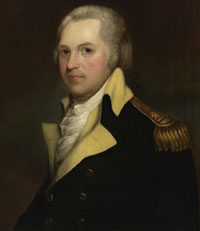
Henry Lee III was born in Virginia in January 1756. The Leesylvania Plantation on the Potomac River where he was born is a state park today. He was one of eight children. His father, Henry Lee II, was a colonel in the Virginia militia and also a long-time legislator. His brother, Charles Lee, would later serve as attorney general under President George Washington.
Lee was very talented and graduated from what is now Princeton University in 1773 at age 17. He was preparing for a career as an attorney when the American Revolution started. In June 1776, at age 20, he was commissioned as a captain of a cavalry unit that was quickly absorbed into the Continental Army. In 1778, he was promoted to major and given command of what became known as Lee’s Legion, a combined unit of cavalry and infantry. His hit-and-run tactics kept the British reeling and resulted in a number of American victories.
At the Battle of Paulus Hook in in 1779, his nighttime raid on a British fort inflicted heavy casualties and hastened the British withdrawal from the state. Lee took 158 British troops prisoner. His flair and his skills as a military leader and horseman led to him earning the nickname “Light-horse Harry.” For his actions at Paulus Hook, the Continental Congress honored him with a gold medal, its highest honor, and a $15,000 bonus which he distributed to his men. In spite of his battlefield successes, he often faced jealousy and opposition from other officers. At one point, he faced a court martial but was acquitted of all charges.
By the time of the Battle of Yorktown in 1781, Lee had risen to the rank of colonel. He was present at the official surrender of the British. After the end of the war, he stepped away from the army and returned to his plantation.
After the war, Lee served in Congress from 1786 to 1788. In 1789, he was elected to the Virginia General Assembly. In 1791, he was elected governor and served for three years. Virginia’s Lee County, in far southwestern Virginia, was named for him in 1792. In 1798, he was elected to Congress where he served one term.
Many mourned the passing of George Washington when he died in December 1799. Thousands attended his funeral. Lee delivered the eulogy for him and delivered the famous lines about Washington that were quoted for years afterward: “First in war, first in peace, and first in the hearts of his countrymen.”
When fears of war haunted the United States, first against France in the late 1790s and then against Britain in the early 1800s, both Presidents John Adams and Thomas Jefferson turned to Lee. He was commissioned as a general and began organizing troops before the threats of war faded, and he was given an honorable discharge.
In his later years, however, he suffered serious money problems. He lost much of his fortune in a financial panic in 1796 and continued to suffer reverses afterward. By 1809, he had fallen into bankruptcy. As the modern bankruptcy process of renegotiating debts or dissolving assets did not yet exist, he was forced to endure the humiliation of spending a year in a Virginia debtor’s prison.
When the United States declared war on Britain in 1812, Lee was again ready to serve the nation. He asked President James Madison to give him a command, but Lee never saw action. A few days later the war began, a Baltimore mob attacked his friend Alexander Hanson, a newspaper editor who was critical of the War of 1812 and Madison’s policies. Lee protected his friend from the mob but was beaten and severely injured by rioters. Lee never fully recovered from his injuries and quietly stepped away from public life.
Lee married twice. His first wife died at age 1790 after eight years of marriage. In 1793, he remarried. He had nine children, seven of whom survived to adulthood. His children would leave their own marks on American History. His third son, Henry Lee IV, born in 1787, was a noted historian and also a speechwriter for Andrew Jackson. His eighth child and youngest son, Robert E. Lee, born in 1807, became the noted Confederate general during the Civil War. Light-horse Harry Lee died in March 1818 at age 62.