This past week, I was sitting in an elevated hunting blind in Kaufman County, the guest of my good friends Edgar and David Cotton. My goal was to harvest a fat whitetail doe or possibly a management buck. The ranch is on TPWD-managed lands program with a quota of bucks and doe that need to be removed by special permit rather than the tags on one’s hunting license. Several management or ‘cull’ buck had shown up on camera and I was hunting a stand where several had been seen recently.
I had been watching a two-year-old spike that was a likely candidate for the meat pole and ultimately the freezer. Light was getting low and the buck had disappeared into the brush. I was filming the hunt for our weekly TV show “A Sportsman’s Life” and watched the buck ease out of a treeline about 150 yards to the east. With the low light conditions, I decided not to make the shot, I had passed on the buck at close range early in the hunt and decided not to make the “iffy” shot in low light. There was no more than a couple minutes of shooting light left and that was for shots much closer than 150 yards.
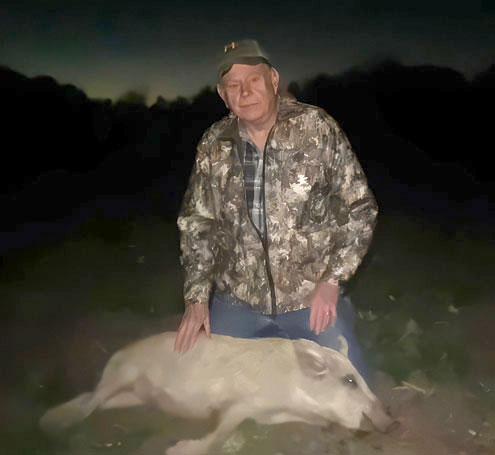
Then, the possession of wild hogs began. A group of about twenty porkers came out of a big creek bottom near where the buck was standing. As luck would have it the hogs came my direction at a trot. I was guessing they were heading to the food plot I was hunting over; they probably smelled the corn and protein feed about 75 yards from where I was hunting. The first group stopped to munch on turnips about 100 yards out from my stand and then, a steady string of porkers emerged from the creek bottom. I noticed a light-colored hog in the group and through binoculars, I could tell it was snow white. In all my years of hunting hogs, I had only encountered one white one and that was years ago.
Feral hogs are a mixture of every breed from Yorkshire to true European boar and the vast majority of them are dark colored. It’s not uncommon to occasionally see a spotted hog or one marked with a white strip like a domestic Hampshire but snow-white hogs in the wild are extremely rare.
Many of my buddies kid me that I could turn a hunt for hippopotamus in Africa into a hog hunt and this is actually not far from the truth. I killed my first mule-foot hog in southeast Oklahoma a couple years ago on land owned by the Choctaw Nation and had a unique mount made from the feet.
When the white hog began following the sounder toward my end of the food plot, I eased my rifle into shooting position watched a steady stream hogs head my direction; there were about 40 in the group. They stopped to feed a bit and I knew it was now or never if I wished to finally have the opportunity to shoot my ‘ghost hog’.
Through my scope, I could still barely make out the dark hogs but the light-colored one made a much easier backdrop for the scope’s crosshairs. With the hog quartering to me at 120 yards, I squeezed the trigger. The big sounder vacated the field in a matter of seconds, but my white porker was anchored where I shot her.
I paced the 120 yards to the hog and found I had shot the perfect ‘eater’ hog; a young sow that weighed about 60 pounds and a prime candidate for a big pot of smoked chili that I was planning to make.
I enjoy cooking and eating wild game almost as much as I do ‘procuring’ it from the wild. I often plan how I will prepare the meat even before I harvest it and, on this hunt, my plan was to make a big pot of smoked venison or wild pork chili. In this case, my option was obviously pork. I’ve been making chili from pork for years and many of my friends are surprised to learn they can hardly distinguish the flavor from chili made from venison.
The evening temperature was cool and I quartered the little hog and let the meat chill overnight. Early the next morning, I decided to use a fillet knife and dice up the backstraps and hams into chili meat. I have a big electric meat grinder but decided I wanted to make the pork chili a bit chunky, thus the reason for using a knife.
Smoking chili meat adds a lot of flavor and the process is relatively easy. I make chili in one of my big Dutch kettles. First, I place the kettle full of diced meat into the smoker with a heavy smoke of hickory or pecan. It’s important to stir the meat every thirty minutes or so to make sure all the meat is exposed to the smoke.
Next, I add my chili seasonings. I’ve found the Wicks Fowler kits have most of the spices I like in chili, but I usually add a bit more cumin and, depending upon the amount of chili I’m cooking, more minced garlic. This was a huge pot of chili and I used two of the chili kits and added a bit more salt, garlic and cumin. A basic recipe of chili powder, cumin, paprika, red pepper and salt also makes a tasty chili.
After the meat is thoroughly smoked for a couple of hours, I add all the seasonings and a can of crushed tomatoes and Rotel and a chopped onion, cover with a lid and let it simmer in the smoker for several hours. The tender meat from the younger hog was fork-tender after five hours of slow cooking in the smoker. I forgot to mention that I added a couple of cans of red kidney beans, but that’s optional. I understand some of my misinformed Texans believe beans are not an acceptable addition to chili.
I enjoyed a big bowl of chili topped with fresh green onion and cheese, and the remainder went into my freezer. I plan to take the meat from my ‘Ghost Hog’ back over for a camp meal at the Cotton camp. Only fitting, don’t you think?
Listen to Luke’s weekly radio show/podcast “Catfish Radio with Luke Clayton and Friends” about everywhere podcast are found. Email Luke through his website www.catfishradio.org.